Staff augmentation vs outsourcing vs a dedicated team
Three ways to add people, and the one question that decides which you need
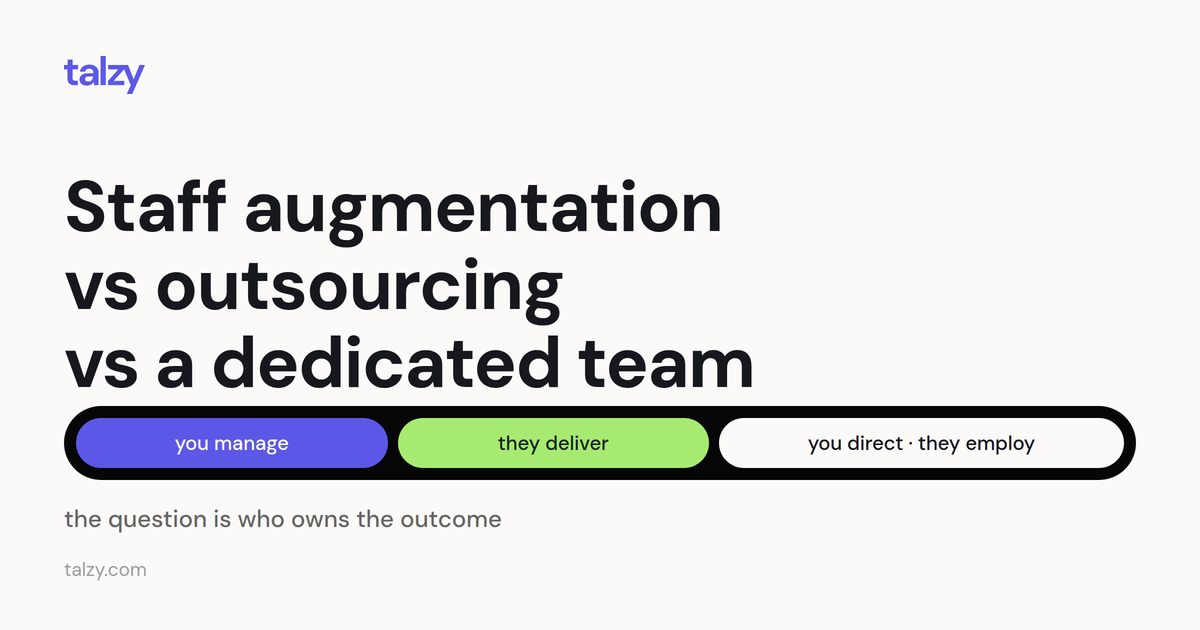
Staff augmentation adds people to your team and you manage them. Outsourcing hands a project to someone else who manages it. A dedicated team sits between: your people, your direction, their employment and structure. The deciding question is who owns the outcome.
Staff augmentation adds people to your team and you manage them. Outsourcing hands a project to someone else who manages it. A dedicated team sits between: your people, your direction, their employment and structure. The deciding question is not price. It is who owns the outcome.
The three terms get used interchangeably in sales conversations, and the difference only becomes obvious later, usually when something has gone wrong and nobody is sure whose job it was to catch it.
Staff augmentation
You need three more engineers. A partner finds them, employs them, and they join your team. They attend your standups, work in your repos, take your priorities.
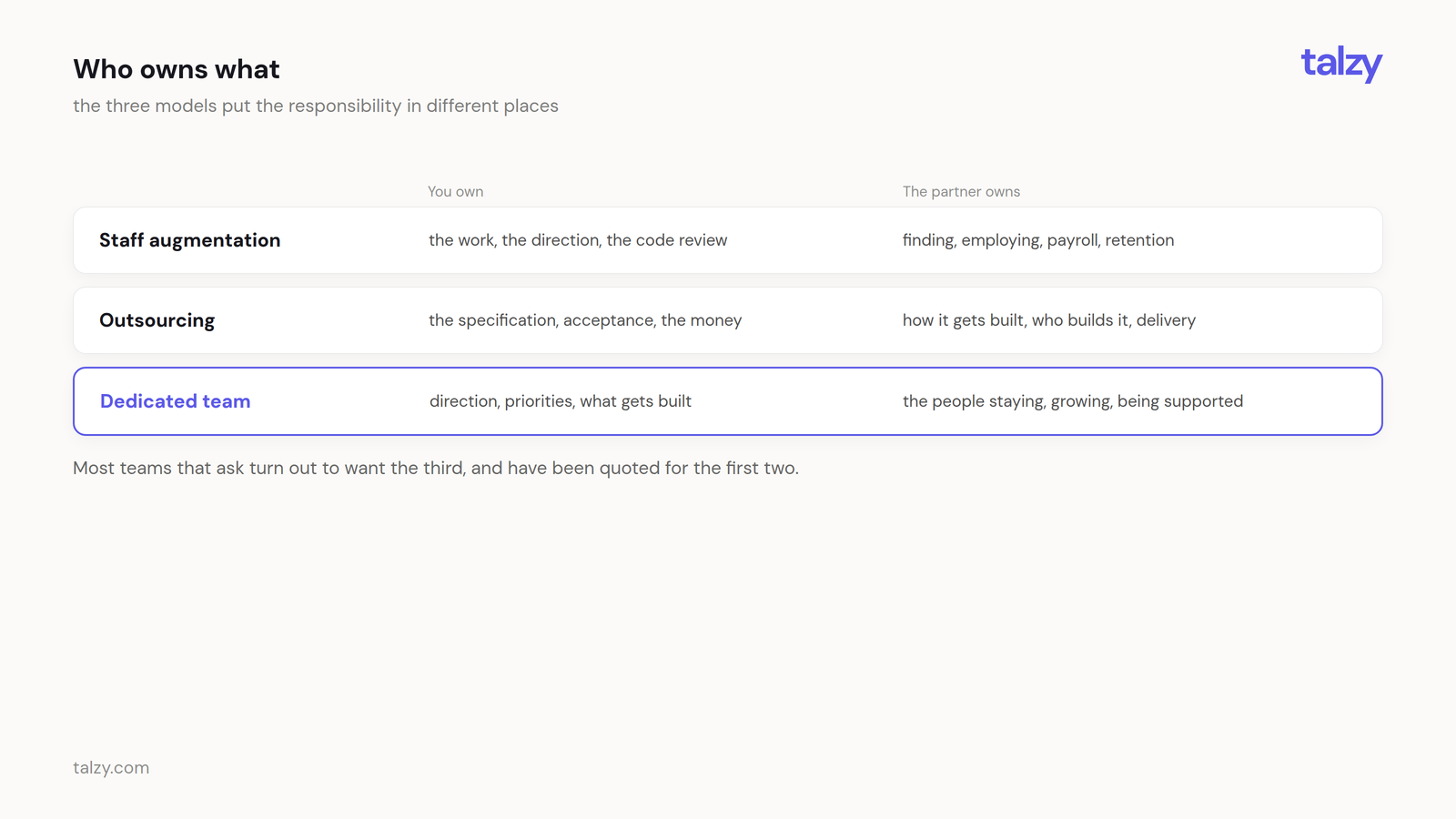
You own: the work, the direction, the code review, whether they are set up to succeed.
The partner owns: finding them, employing them, payroll, equipment, and keeping them in the job.
What it is good for. Adding capacity to a team that already knows what it is building. If you have a technical lead who can direct people, this is the most efficient model there is, because there is no translation layer between decision and execution.
Where it goes wrong. When nobody on your side has time to direct them. An augmented engineer with no direction produces very little, and it is not their fault. This is the single most common failure mode and it is entirely preventable.
Outsourcing
You have a defined piece of work. A vendor takes it, staffs it their way, and delivers against a specification.
You own: the specification, acceptance, and the money.
The vendor owns: how it gets built, who builds it, and delivering on time.
What it is good for. Genuinely bounded work with a clear finish. A mobile app to a spec. A migration. An integration. Anything where you can describe done in advance and do not need to be involved in how.
Where it goes wrong. When the scope was not as clear as everyone thought, which is most software. Then you are in change requests, and the model's incentives pull against yours - you want the thing to be right, they want it to match the spec that was signed.
Also worth naming: when the project ends, everything the team learned about your business leaves with them.
A dedicated team
People who work only for you, employed by a partner. You set priorities and they work as your team. The partner handles employment, equipment, HR, and the things that keep people in a job.
You own: direction, priorities, and what gets built.
The partner owns: the people staying, growing and being supported.
What it is good for. Long-running product work. Continuity is the whole point - the same people accumulate context about your product, your customers and your decisions, and that compounds in a way project work cannot.
Where it goes wrong. When it is bought as outsourcing. If you expect a dedicated team to run itself while you check in monthly, you have paid for a model you are not using. It still needs direction; what it does not need is your HR.
The question that decides it
Not price. Who owns the outcome?
If you own the outcome and just need more hands, that is staff augmentation.
If you want someone else to own the outcome and you will judge the result, that is outsourcing.
If you own the outcome and want to stop owning employment, that is a dedicated team.
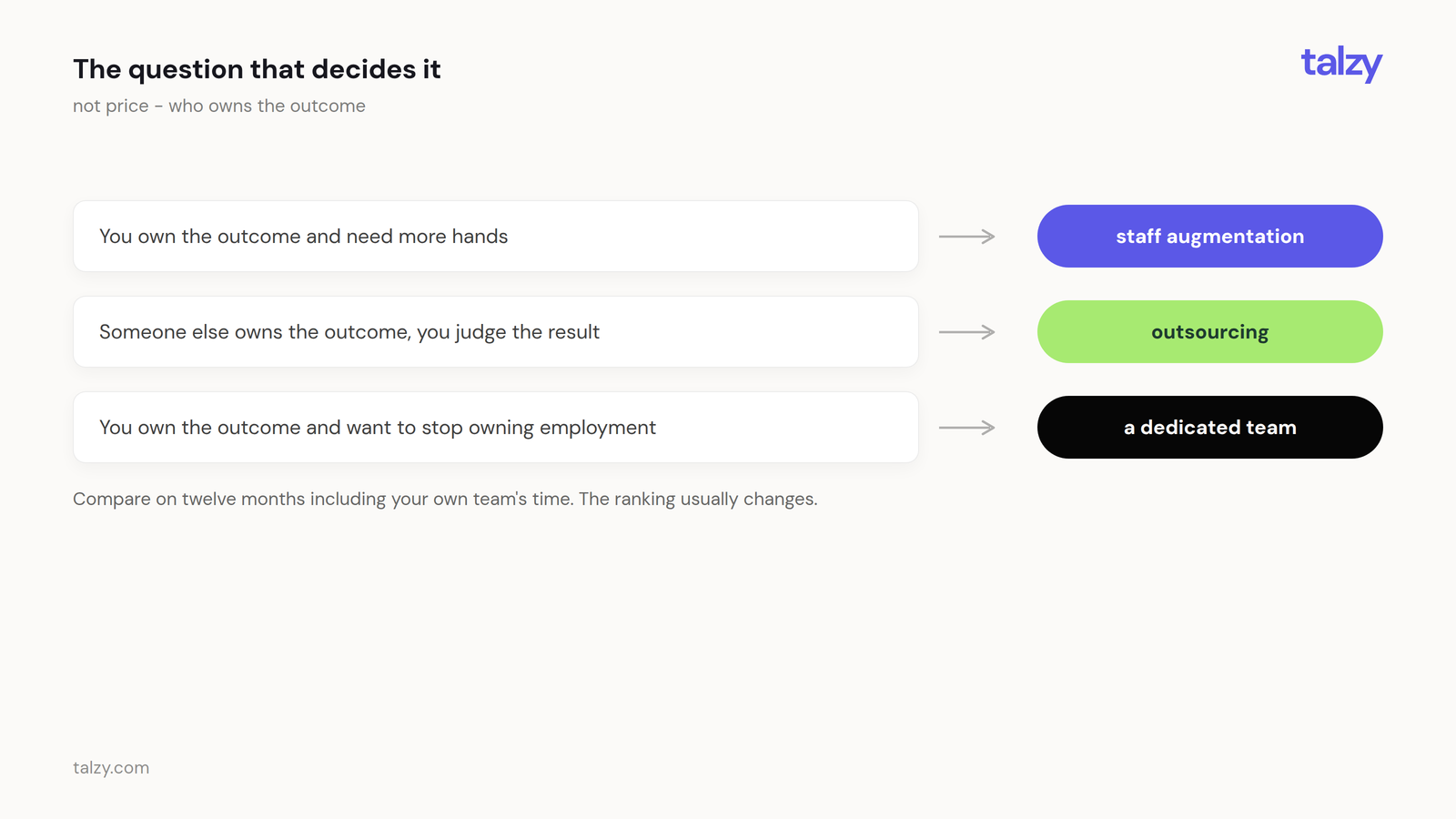
Most teams that ask us this question turn out to want the third and have been quoted for the first two.
What it actually costs
Rate cards mislead, because the models put the cost in different places.
Outsourcing looks cheapest per hour and carries the highest coordination cost - specification, acceptance testing, change requests, and the meetings that go with them. That work is real and it lands on someone senior on your side.
Staff augmentation costs more per person and less in overhead, once people are embedded. Before they are embedded it costs both.
A dedicated team sits in the middle on rate and lowest on total cost over a year or more, because nothing gets re-explained and nobody gets re-recruited.
Compare on twelve months including your own team's time. The ranking usually changes.
What we do
We place people into your team, in Latvia, Lithuania and Poland, and we employ them locally - engineers, QA, technical PMs and support. That is staff augmentation by default and grows into a dedicated team when the group gets big enough to have its own shape.
We do not take fixed-scope projects. Not on principle - it is a different business with different economics, and we would be worse at it than the firms who specialise.
If what you need is a bounded project delivered to a spec, we will say so and you should talk to someone else. If what you need is people who become part of your team and stay, that is the thing we are built for.
Starting small is reasonable
Most teams that end up with five or six people with us started with one.
That is a sensible way to run it. One engineer tells you whether the working relationship functions, whether the timezone overlap is enough, and whether your onboarding is good enough to bring someone in remotely. All three are cheaper to learn on one person than on five.
Frequently asked questions
Evaluating how to build your European team?
Tell us the role and team size. We'll send an honest read on whether Talzy is the right partner - and if it is not, we'll tell you that too.