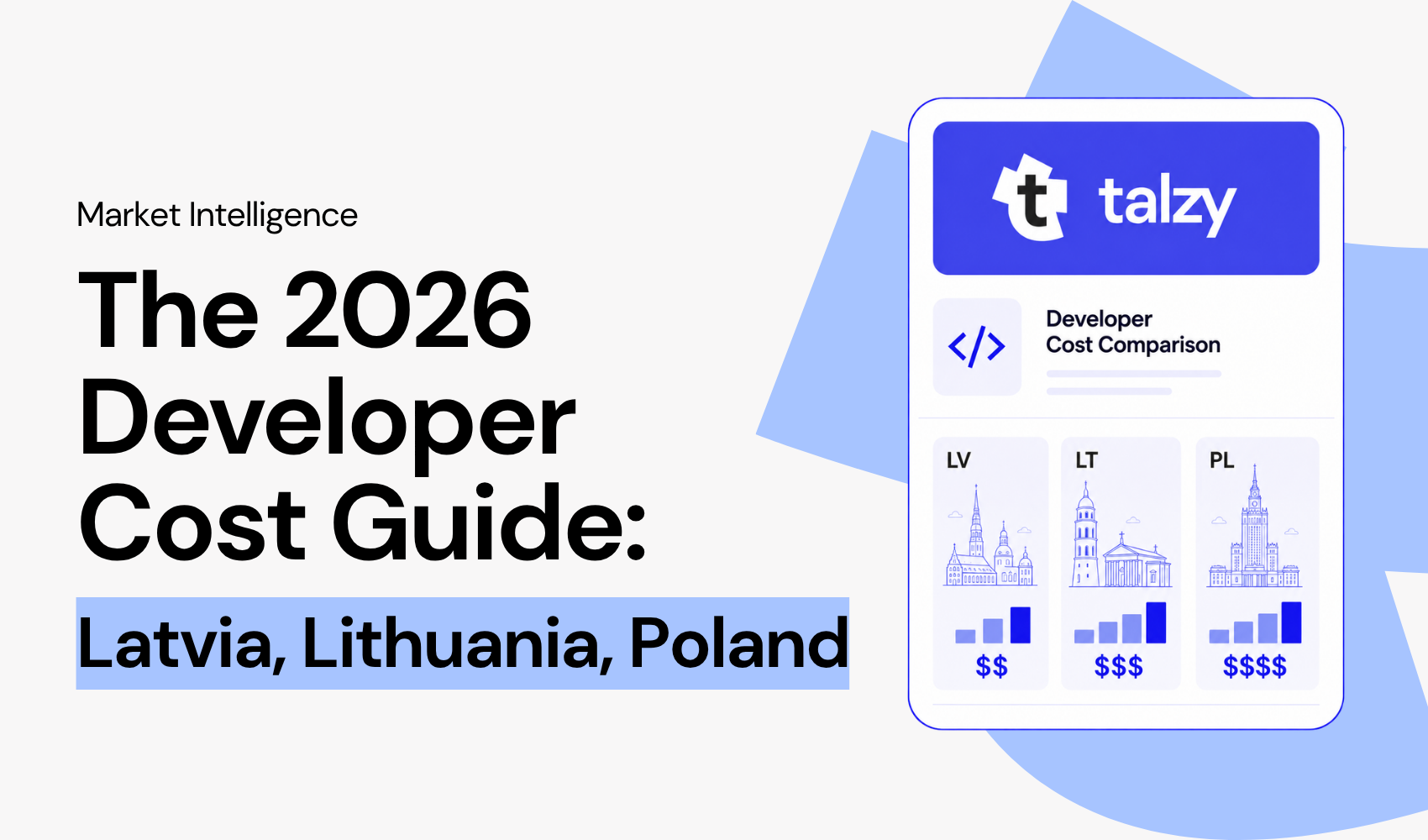
Gross salary is the cheapest line in the equation. Employer contributions, recruitment, ramp-up, equipment, and retention churn typically add 35–60% on top — and they decide whether your CEE hire actually works.
If you have ever asked an outsourcing agency or an EOR sales rep "what does it actually cost to hire a developer in CEE?", you have already encountered the problem this guide tries to solve: the answer is almost always a gross salary number, and the gross salary number is the smallest line in the equation.
What follows is the real total cost of hiring a software developer in 2026 across the three markets where Talzy operates — Latvia, Lithuania, and Poland— broken down by role, seniority, and the categories of cost that don't appear in any salary survey but absolutely show up on your books.
Numbers below are anchored to two sources: Talzy's live calculator (which reflects current placement data across 60+ engineers we have hired since 2023) and public market data from national statistical offices and the Bulldogjob Polish IT Salary Report. Per-source citations are inline. The methodology section explains how the ranges were assembled — and what their limitations are.
Methodology — and the limitations
Three data sources feed every number in this guide.
1. Talzy placement data. Since 2023, we have placed engineers across Latvia, Lithuania, and Poland for Series A–C clients in North America and Western Europe. Live, per-role numbers from this dataset are published on the live cost calculator and updated quarterly. Where this guide cites a specific cell, it reflects either the live calculator value or a range bounded by recent placements.
2. National statistical offices. Latvia: Centrālā statistikas pārvalde (CSB) ICT sector wage tables. Lithuania: Lietuvos statistikos departamentas Sodra/contribution rates plus ICT wage data. Poland: Główny Urząd Statystyczny (GUS) plus Eurostat ICT sector averages.
3. Public IT salary surveys.Poland: the Bulldogjob IT Salary Report 2025 (the most-referenced public Polish IT wage survey). Latvia and Lithuania: less mature survey ecosystems, so figures here lean more heavily on Talzy's own placement data with national statistical office data as the cross-check.
All monthly figures in this guide are gross to the employer in USD unless otherwise marked. Conversion to EUR uses the May 2026 monthly average. Where ranges are shown, they reflect the 25th–75th percentile band across the role/seniority combination.
A note on limitations. These ranges are 2026 estimates assembled from the sources above; they are not a single statistically representative dataset. Individual placements vary with stack, specialisation, niche skills, and negotiation outcome. Treat the table as a planning baseline, not a quote — and use the live calculator for the latest specific role/country/seniority cell.
The TL;DR table
Monthly gross salary (USD) — the starting point of the equation, before employer contributions and the rest of the hidden costs.
| Role | Seniority | Latvia | Lithuania | Poland (ex-Warsaw) | Poland (Warsaw) |
|---|---|---|---|---|---|
| Fullstack | Mid | $2,800–3,400 | $2,700–3,300 | $3,500–4,500 | $4,200–5,000 |
| Fullstack | Senior | $3,800–4,800 | $3,700–4,600 | $5,000–6,500 | $5,800–7,500 |
| Fullstack | Lead | $5,200–6,500 | $5,000–6,300 | $7,000–9,500 | $8,200–10,500 |
| Backend | Mid | $2,900–3,500 | $2,800–3,400 | $3,600–4,600 | $4,300–5,200 |
| Backend | Senior | $4,000–5,000 | $3,900–4,800 | $5,200–6,800 | $6,000–7,800 |
| Backend | Lead | $5,400–6,800 | $5,200–6,500 | $7,300–9,800 | $8,500–11,000 |
| Frontend | Mid | $2,600–3,200 | $2,500–3,100 | $3,300–4,300 | $3,900–4,800 |
| Frontend | Senior | $3,500–4,400 | $3,400–4,300 | $4,600–6,000 | $5,400–7,000 |
| Frontend | Lead | $4,800–6,100 | $4,600–5,900 | $6,600–8,800 | $7,800–10,000 |
| DevOps | Mid | $3,200–3,900 | $3,100–3,800 | $4,000–5,100 | $4,700–5,800 |
| DevOps | Senior | $4,300–5,300 | $4,200–5,200 | $5,600–7,200 | $6,500–8,300 |
| DevOps | Lead | $5,800–7,200 | $5,600–7,000 | $7,700–10,200 | $9,000–11,500 |
| Data Engineer | Mid | $3,000–3,700 | $2,900–3,600 | $3,800–4,900 | $4,500–5,500 |
| Data Engineer | Senior | $4,100–5,100 | $4,000–5,000 | $5,400–7,000 | $6,300–8,000 |
| Data Engineer | Lead | $5,500–6,900 | $5,300–6,700 | $7,400–10,000 | $8,700–11,200 |
For Machine Learning, QA, Mobile, and Software Developer roles — all part of the 9 roles we hire for — live numbers update on the calculator as you change selections.
Latvia: small market, dense engineering community
Latvia's engineering market is smaller than Lithuania's and an order of magnitude smaller than Poland's. Riga is the centre of gravity — 70%+ of senior-level engineering talent in the country sits within commuting distance of the city — and the secondary cities (Liepāja, Daugavpils, Valmiera) contribute a handful of engineers each but not a deep pool.
Latvia's gross salary ranges are the lowest of the three markets at every seniority level. A Senior Fullstack engineer in Riga in 2026 typically lands at $3,800–$4,800/month gross. The structural reason: Latvia's median tech wage growth has trailed Lithuania and Poland over the last three years, partly because of slower currency appreciation and partly because the smaller market has less cross-border bidding pressure.
The catch nobody mentions: Latvia's employer social contribution rate is the highest of the three at 23.59%. On a Senior Fullstack gross of $4,484, the employer pays an additional $1,057/month in social contributions. Add Talzy's flat service fee of $1,416/month and the all-in monthly cost lands at $6,957 — or $83,487/year — versus a comparable fully-loaded US hire at $127,680/year. That's a 35% saving / $44,000/year delta.
One non-obvious advantage of Latvia for North American teams: cultural alignment. Riga is the most westernised CEE capital — direct flights to Stockholm, Copenhagen, Berlin, London — and the engineering culture leans hard toward Northern European norms (process discipline, written communication, low political theatre). Retention of senior-level engineers is high when employment is structured correctly. Across our Latvian placements, the annualised churn rate sits under 8% — well below the CEE remote-only average. The mechanism behind that number is in how we structure the engagement: local employment, real office presence, and an account partner who is not the engineer's line manager.
Lithuania: where employer contributions are deceptively low
Lithuania's market sits between Latvia and Poland in size. Vilnius is the dominant centre, with Kaunas as a meaningful secondary city and Klaipėda contributing a small share. Engineering talent depth has grown materially since 2020 — partly driven by fintech (Revolut's Lithuanian licence, Vinted, Nord Security) absorbing a generation of senior engineers and creating a deep mid-to-senior bench.
Gross salary ranges in Lithuania are marginally lower than Latvia at Mid level and marginally higher at Senior+ — reflecting the fintech wage pressure on senior talent specifically. A Senior Fullstack in Vilnius in 2026 typically lands at $3,700–$4,600/month gross.
The structural quirk that catches every North American CFO comparing CEE for the first time: Lithuania's social contribution system is inverted relative to Latvia and Poland. Since the 2019 Sodra restructure, the employer pays approximately 1.77% of gross salary in social contributions — a tiny fraction of the rate in either neighbouring country. The employee, meanwhile, carries approximately 19.5% Sodra plus a progressive income tax (GPM) of 20% on income up to roughly €120K/year and 32% on the excess.
Net pay to the engineer ends up comparable to what they would earn in Latvia, but the line on the employer's invoice looks dramatically lower. This is where back-of-envelope CEE comparisons fall apart.
A naive comparison saying "Latvia is cheaper because gross is lower" misses the 22-point spread in employer contributions — which, at Senior+ levels, can flip the total cost calculation in Lithuania's favour by $200–$400/month per engineer. Whether that maths into a meaningful annual delta depends on team size and seniority mix; we model both scenarios for every prospect that talks to us about a Lithuanian team.
One thing to watch in Lithuania: fintech wage pressure. The same companies that built the Senior-level talent pool also bid prices up for the people they hired. If you are hiring competitively against Revolut, Vinted, or Nord Security for an engineer with payments / KYC / cybersecurity experience, expect to pay 15–25% above the ranges in the TL;DR table.
Poland: the largest market, with Warsaw premium
Poland is roughly five times the engineering market of Latvia and Lithuania combined. The depth is real — and so is the price. Warsaw, Kraków, Wrocław, Gdańsk, and Poznań each have a substantial engineering community, and Warsaw is the clear premium city.
The Warsaw premium is consistently 15–25% across roles and seniorities. A Senior Fullstack in Kraków or Wrocław in 2026 typically lands at $5,000–$6,500/month gross; the same engineer in Warsaw lands at $5,800–$7,500/month. The Bulldogjob IT Salary Report 2025 confirms a Warsaw spread of approximately 20% above the national median, consistent with what we have observed on 2025–2026 placements.
Poland's employer social contribution structure is closer to Latvia's than Lithuania's: ZUS (Zakład Ubezpieczeń Społecznych) plus the Labour Fund add up to approximately 19.21% on top of gross, with some variance based on the employee's age and disability status. Personal income tax for the engineer is 12% on the first ~$30K/year and 32% above that.
What makes Poland different from Latvia and Lithuania structurally: the B2B-contractor route. A meaningful share of Polish senior engineers work as B2B sole proprietors rather than employees, taking advantage of a flat 12–19% IT-tax regime instead of progressive PIT. This changes the math in two directions: lower employer contribution if you contract directly, but also no employer-employee legal relationship — which has consequences for retention, IP assignment, and how engineers feel about the work. Our default model in Poland is employment via our Polish entity, not B2B contracting, because the retention math is clearly better — but the B2B route exists if your specific situation requires it.
The hidden costs that don't make it onto the salary line
If gross salary plus employer contributions is the headline cost, the real total cost includes four more lines that almost never appear in comparison material.
Recruitment. In-house recruiter time and tooling typically runs $4,000–$8,000 in fully loaded cost per hire for a Mid/Senior CEE engineer. Using an external recruiter, the CEE market rate is 15–25% of first-year gross salary — so $8,000–$15,000 for a Senior. This is the most variable line item across hires and the one most likely to be invisible until you tally it.
Ramp-up.2–4 months of partial productivity from hire date is the standard CEE benchmark. The "ramp-up cost" is what you pay the engineer during the period before they are contributing at full velocity. Assuming linear productivity ramp and a $5,000/month all-in cost, ramp-up typically costs $5,000–$10,000 in lost-productivity-adjusted compensation per hire.
Equipment and workspace. Laptop ($1,800–$2,500 amortised over 3 years), peripherals ($400 one-time), workspace/office contribution ($150–$400/month per engineer if you provide it), software seats ($100–$250/month per engineer). At Talzy this is bundled into the flat workspace fee of $354/month per engineer, alongside the rest of the operations layer; if you are handling it yourself, expect to budget approximately $300–$500/month per engineer in fully loaded equipment + workspace + tooling.
Retention churn.The most expensive cost line — and the one most companies don't measure. CEE engineering turnover in remote-only models without local support averages 22–30% annualised based on cross-industry studies of distributed teams. Each departure resets the recruitment and ramp-up clock. At a 25% turnover rate, the full-cycle replacement cost per role per year — when you account for sourcing, ramp-up, and lost institutional knowledge — typically lands at $15,000–$30,000. Reducing turnover from the remote-only baseline to the ~8% we observe under properly structured local employment is the single largest cost-saving line item over a 2-year engagement, and it's the one that never shows up on a side-by-side pricing page.
Total cost of engagement — a worked example
Take a single Senior Fullstack engineer in Vilnius. Two-year horizon. Gross salary $4,200/month (midpoint of the Lithuania Senior Fullstack range). How do the four hiring models compare on total cost over 24 months?
Option 1 — EOR (Deel / Remote). $4,200 gross × 24 = $100,800 in salary. Lithuanian employer contribution at 1.77% = $1,783. EOR platform fee at $650/month × 24 = $15,600. You source the engineer yourself — assume $10,000 in fully loaded recruiter cost. Ramp-up cost (linear productivity month 1–3) = $7,500. Equipment + workspace for 24 months at $300/month = $7,200. Retention risk: no local support, isolated remote model, 25%+ turnover risk over 24 months — assume one mid-cycle replacement at +$25,000. Total: ~$167,883 over 24 months. (Side-by-side feature comparison: Talzy vs Deel.)
Option 2 — Outsourcing agency. Agency bills at $5,000 engineer rate plus 80–100% markup = $9,000–$10,000/month all-in. Take the midpoint: $9,500 × 24 = $228,000 over 24 months. No additional recruitment, ramp-up, or equipment — bundled. But: no direct ownership of the engineer, no entity-graduation path, and the engineer's loyalty runs to the agency, not your company.
Option 3 — Traditional hiring (your own Lithuanian entity). Entity setup: $8,000–$15,000 one-time plus $3,000–$5,000/year ongoing accounting and admin. Salary $4,200 × 24 = $100,800. Employer contribution $1,783. Recruitment $10,000 in-house or $13,000 external. Ramp-up $7,500. Equipment + workspace $7,200. Retention: depends entirely on you. Assume same 8% best-case retention through proper management: no replacement cost. Total: ~$148,283 over 24 months — but only if entity overhead amortises across multiple hires.
Option 4 — Talzy.Engineer salary pass-through at $4,200 × 24 = $100,800. Lithuanian employer contribution: 1.77% × $100,800 = $1,783 (handled by Talzy, billed at-cost). Talzy service + workspace fee: $1,416/month × 24 = $33,984. Sourcing, recruitment, equipment, workspace, retention support: included. One-off hiring fee: one month's gross = $4,200. Our observed retention rate of ~8% annualised means no replacement assumption over 24 months. Total: ~$140,767 over 24 months.
On this specific example, Talzy comes in lowest by a small margin over the own-entity path — and by a meaningful margin over EOR and outsourcing. Change the assumptions (team size, turnover rate, recruitment route, entity amortisation horizon) and the ranking changes. The point of the worked example is the shape of the calculation, not the winner of any one row.
The full hiring-model comparison — when each model is actually right, and when it isn't — is in the four ways to hire an IT engineer in Eastern Europe. This article is the per-country numerical companion.
What this means for your hiring decision
The headline takeaway is unromantic: gross salary differences between Latvia, Lithuania, and Poland are real but smaller than most North American CTOs assume. Where the real spread shows up is in employer contribution rates (Lithuania is dramatically lower), market depth (Poland is dramatically larger), retention dynamics (Latvia tends highest, Lithuania mid, Poland variable by city), and the hidden costs that don't make it into salary surveys.
Rough heuristics from the placements we have run:
- 1–2 engineers, want simplicity → Latvia tends to be the cleanest choice. Smaller market, but high retention and cultural alignment with N. American teams.
- 3–10 engineers, want depth without Warsaw pricing → Lithuania, or Kraków / Wrocław.
- 10+ at speed, depth matters more than per-engineer cost → Warsaw delivers, at a 20% premium.
The thing the comparisons in this guide can't capture is the management overhead difference between the four models. A pass-through structure eliminates the entity-setup decision entirely; an EOR forces you to source independently; an agency removes your direct relationship with the engineer; traditional hiring puts the full operational burden on you. Per-country pricing is a real variable — but it's not the variable that determines whether your team works.
If you are working through this decision now and want a second opinion on the math for your specific shape — role mix, team size, country, timeline — tell us a bit about the situation. We'll come back with an honest read on which model fits, even if the answer is "don't hire in CEE yet."