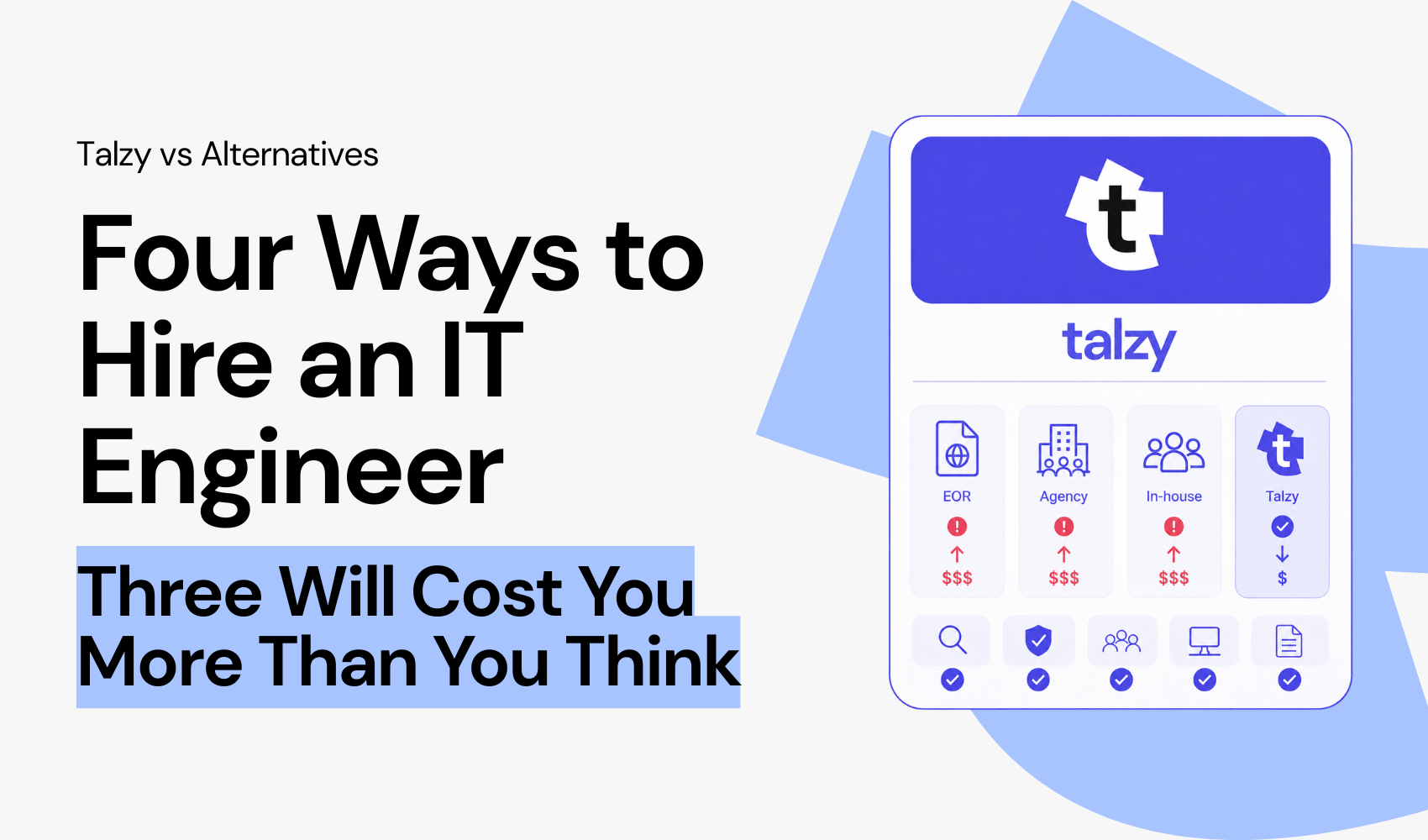
There are four ways a company can bring an IT engineer onto their team from Eastern Europe.
You can use an Employer of Record platform like Deel or Remote. You can hire an outsourcing agency. You can set up a local entity and hire traditionally. Or you can work with Talzy.
Every option has its advocates. Every option has its pitch deck. And every option has costs, risks, and limitations that rarely come up until you are already committed.
This is the article that lays all of that out - without the usual diplomatic softening.
The Problem with How Most Companies Think About This
When a company decides to hire an IT engineer in CEE, they typically approach it as a binary choice: outsource the work, or find a way to employ someone directly. What they are actually choosing between is four fundamentally different models - each with a different cost structure, a different risk profile, and a different answer to the question of who is really responsible for making this work.
Getting that choice wrong is expensive. Not just financially - though the financial cost is real and often larger than expected - but in time, in management overhead, and in what happens when things do not go as planned.
Here is what each model actually looks like when you move past the sales material.
Option 1: Deel, Remote, and the EOR Model
What they are selling
Employer of Record platforms handle the legal and compliance layer of employing someone in a foreign country. They become the official employer on paper. You direct the work. They handle payroll, taxes, social contributions, and local labour law compliance. It sounds clean.
What they are not telling you
They do not find you anyone.
This is the most important thing to understand about EOR platforms. Deel, Remote, and every platform like them are compliance wrappers, not talent networks. You still have to source, vet, interview, and select the engineer yourself - and then hand them to the platform to employ.
That means the 2–4 months most companies spend finding a good engineer is entirely on you, before the platform even enters the picture. The platform clock starts when you have already done the hard work.
The fees are not as simple as they appear.
EOR platforms typically charge a flat monthly fee per employee - often in the range of €500 to €700 per person per month - on top of the full agreed salary and any local employer contributions. For a mid-level engineer on a €4,000 monthly salary, you are looking at total employer costs that can exceed €5,500 per month once you add local social contributions (which vary materially by country) plus the platform fee.
Over 12 months, that adds up. And you are paying it for a compliance service - not for finding, vetting, managing, or retaining your engineer.
There is no one in your corner when things go wrong.
If your engineer underperforms, burns out, or resigns - the platform does not help you fix that. They process the offboarding. They do not know your engineer, they did not hire your engineer, and they have no particular interest in retaining your engineer. You are back to sourcing from scratch.
The retention problem is invisible until it hits you.
EOR engineers often work in a strange limbo - technically employed by a platform, culturally isolated from both the platform and the client company. There is no local team, no office, no colleague to grab a coffee with, no one investing in their career development. The research on remote work is clear: isolation drives turnover. And every time an engineer leaves, you absorb the full cost of sourcing, interviewing, and onboarding all over again.
Option 2: Outsourcing Agencies
What they are selling
A team or individual engineer, delivered quickly, managed by the agency. You describe what you need, they put someone in front of you, and the work gets done. Simple.
What they are not telling you
The engineer is not yours.
This is the defining structural problem with outsourcing. The engineer works for the agency. Their career path runs through the agency. Their loyalty - whether they like it or not - is shaped by who pays their salary, manages their performance reviews, and determines their future projects. That is not you.
What this means in practice: the engineer is available until they are not. The agency pulls them onto another client. They get promoted into a different role. A bigger client comes along with a more attractive brief. You have no control over any of it, and often very little notice.
You are paying for margins you cannot see.
Outsourcing agencies typically charge a blended rate that includes a significant markup on the engineer's actual cost - commonly 40–60% above what the engineer earns. On a €5,000 monthly agency invoice, the engineer may be earning €3,000–3,200. The rest is agency overhead, sales cost, account management, and profit margin.
You are not just paying for an engineer. You are paying for an entire agency infrastructure that exists to serve multiple clients, of which you are one.
Accountability is shared, which means diluted.
When something goes wrong on an outsourced engagement - a deadline is missed, quality is below expectation, communication breaks down - the response is rarely swift or satisfying. There are multiple layers between you and the actual cause of the problem: the engineer, their team lead, the account manager, agency management. Each layer adds friction. Each layer slightly deflects responsibility.
Time to first hire is the slowest of any option - 4 to 8 weeks.
Agencies need to assess your requirements, match them internally, check availability across their bench, propose candidates, run you through their own process. That process is built around their operational rhythm, not yours. In a market where engineering talent moves fast, 4–8 weeks to get someone in front of you is slow.
Option 3: Traditional Hiring
What they are selling
Full ownership. The engineer is yours - fully employed, fully integrated, working exclusively for you. No agency margins. No platform fees. Direct relationship.
What they are not telling you
The time cost is brutal.
Traditional hiring in a foreign market takes 2–4 months from start to finish. Posting roles, sourcing candidates, screening CVs, running interview rounds, making offers, handling counteroffers, waiting out notice periods. In a fast-moving company, 3 months without the person you needed 3 months ago is a real operational cost. Projects slip. Teams stay under-resourced. Momentum stalls.
The compliance burden lands entirely on you.
To employ someone traditionally in Latvia, Lithuania, or Poland, you either need a registered legal entity in that country or you need to create one. Setting up a compliant entity in a foreign jurisdiction takes time, legal fees, local accounting support, and ongoing administrative overhead. You need to understand local employment law, termination rules, mandatory benefits, tax obligations - or pay someone to navigate it for you.
None of that overhead is small. And if you are only hiring one or two engineers, the cost-per-hire of maintaining that infrastructure is significant.
You are on your own with retention.
There is no local support network. No office. No colleagues in the same city. Your remote hire is entirely dependent on your company culture, your management, and your ability to make them feel embedded in a team they may never meet in person. Some companies do this well. Many do not. And the cost of losing a traditional hire - after the months of sourcing, the legal setup, and the onboarding investment - is substantial.
What Talzy Is - and Why the Model Is Different
Talzy was built around a single observation: every existing model solves one piece of the problem and ignores the rest.
EOR platforms handle compliance but not sourcing. Outsourcing agencies handle sourcing but not ownership. Traditional hiring gives you ownership but leaves you alone with the compliance, the sourcing, and the retention challenge.
The Talzy model is designed to handle all of it.
Sourcing and vetting - included
Talzy finds the engineer for you. That means active sourcing across our CEE networks, structured technical and cultural vetting, and presenting candidates who have been assessed against your specific requirements. You are not handed a database to search. You are presented with people who have already been qualified.
The engineer works directly for you
Unlike an outsourcing agency, the engineer on a Talzy engagement is your team member. They work your hours, follow your processes, integrate into your team, and build loyalty to your company - not to an intermediary. You direct the work. You own the relationship.
Payroll and compliance - handled
Like an EOR platform, Talzy takes the compliance burden off your plate. Local payroll, social contributions, employment contracts, and labour law compliance are managed by Talzy in each market we operate in. You do not need a local entity. You do not need a local accountant. You pay one transparent monthly fee.
A real local presence
Every market Talzy operates in has established office infrastructure. Your engineer has a place to work, a local team around them, and a physical presence that meaningfully reduces the isolation that drives turnover in remote-only models. This is not a virtual office address - it is a working environment.
Retention and career advocacy
Talzy actively invests in the engineers we place. That means structured career conversations, development support, and active advocacy for their growth within your team. Our retention interest is aligned with yours: an engineer who stays and grows is good for your company and good for ours.
An exit ramp built in
If your company eventually wants to hire in a market directly - setting up your own entity, employing people under your own legal structure - Talzy supports that transition. The entity graduation path exists because the goal is not to keep you dependent on the platform indefinitely. It is to give you the right model for where your company is right now, with a clear path to the next stage.
2–3 weeks to first hire
From first conversation to your engineer sitting at a desk, ready to work - 2–3 weeks. Faster than any agency. Faster than traditional hiring. And unlike EOR platforms, that timeline includes finding the person.
The Direct Comparison
| Talzy | Deel / Remote (EOR) | Outsourcing Agency | Traditional Hiring | |
|---|---|---|---|---|
| Talent sourcing and vetting | Yes | No - you source | Yes | No - you source |
| Engineer works for you directly | Yes | Yes | No | Yes |
| Local office and workspace | Yes | No | Sometimes | No |
| Payroll and compliance handled | Yes | Yes | No | Complex |
| Retention and career advocacy | Yes | No | No | No |
| Entity graduation path | Yes | N/A | No | N/A |
| Time to first hire | 2–3 weeks | Days (you source) | 4–8 weeks | 2–4 months |
The Honest Cost Comparison
For per-country, per-role breakdown with 2026 numbers, see the 2026 Developer Cost Guide: Latvia, Lithuania, Poland — the numerical companion to this piece.
No model is free. But the cost of each model looks very different when you account for the full picture - not just the monthly invoice.
With an EOR platform, you are paying €500–700/month in platform fees plus all employer costs, and you have already spent 2–4 months (and often external recruiter fees) sourcing the engineer yourself before the platform was ever involved.
With an outsourcing agency, you are paying a blended rate that includes 40–60% agency margin on top of the engineer's actual compensation - and you do not own the relationship.
With traditional hiring, the upfront cost in time and legal infrastructure is high, the sourcing timeline is the longest of any option, and there is no support net if retention becomes a problem.
With Talzy, you pay a tiered monthly management fee (€900 starting, scaling down to €500 at 25+ engineers) plus €300 workspace per engineer, on top of the agreed salary passed through at cost. Sourcing, vetting, compliance, workspace, and retention support are all included. You are not paying recruiter fees. You are not maintaining a local entity. You are not absorbing the cost of a 3-month sourcing process before any work begins.
For most companies hiring 1–5 engineers in CEE, Talzy is not just the most complete model - it is the most cost-effective one when the full picture is on the table.
Who Each Model Is Actually Right For
To be fair: not every model is wrong for every company.
EOR platforms make sense if you have already found your candidate independently, you have no immediate need for vetting support, and your primary need is a compliant employment wrapper in a country where you have no entity. They are a good product for that specific use case.
Outsourcing agencies make sense if you need project-based work delivered by a team with no intention of building a long-term direct relationship, and you are comfortable with the cost structure and the absence of direct ownership.
Traditional hiring makes sense if you are scaling seriously in a single market, you want full legal independence, and you have the operational capacity to manage local HR and compliance yourself.
Talzy makes sense if you want to hire engineers who work directly for you, in a compliant and supported structure, without a 3-month wait or a 60% agency markup - and you want someone invested in making those hires stick.