Hire a technical PM in CEE
The role US teams get wrong most often, and what to screen for instead

The technical PM role fails more often than any other placement, and almost always for the same reason: the company hired a coordinator when it needed someone who could argue with an engineer. Screen for technical judgement, not for certification or tooling.
The technical PM role fails more often than any other placement we make, and almost always for the same reason: the company hired a coordinator when it needed someone who could argue with an engineer.
The job description asks for status reports, sprint ceremonies and stakeholder communication. All real. None of them the thing that makes the role work.
What the role actually is
A technical PM is the person who keeps delivery honest.
They know when an estimate is wrong. They can tell the difference between a hard problem and an avoidable one. When two engineers disagree about an approach, they can follow the argument well enough to know whether it needs a decision or just needs time.
That is a judgement job. The ceremonies are the visible part and the least important part.
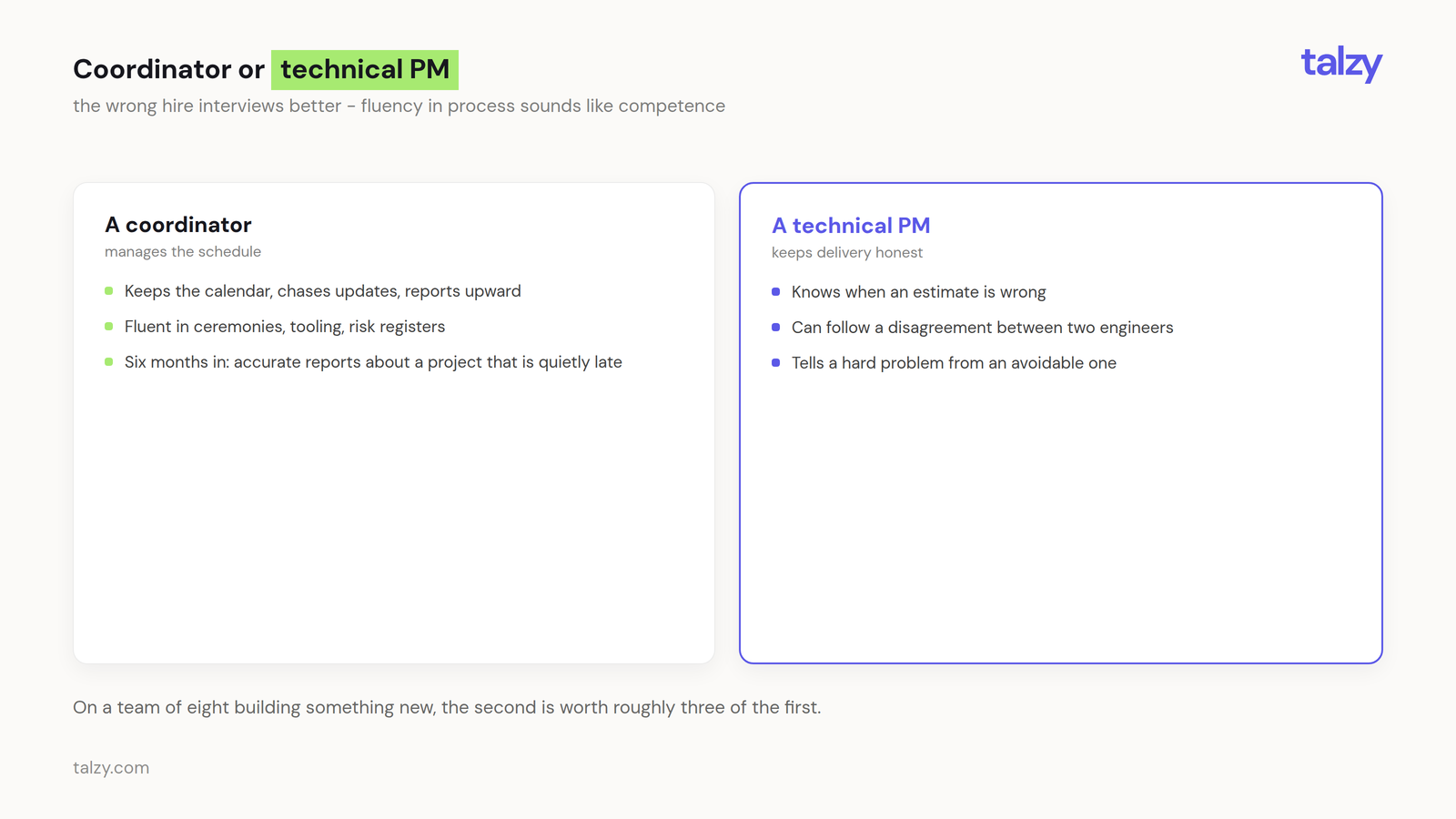
A coordinator keeps the schedule, chases updates, runs the standup and reports upward. Genuinely useful in a large organisation with many moving parts and a fixed plan.
A technical PM does that and engages with the substance. On a team of eight engineers building something new, the second is worth roughly three of the first, because most delivery problems are technical decisions that went unnoticed rather than schedule problems.
Why the wrong hire is so common
Because the wrong hire interviews better.
A coordinator is fluent in process. They speak confidently about ceremonies, tooling, reporting cadence, risk registers. It sounds like competence and it is easy to evaluate.
A technical PM often interviews less smoothly. They ask about the architecture. They want to know why a decision was made. They may seem less certain, because they are thinking about the actual problem rather than the process around it.
Then six months in, the coordinator is producing accurate reports about a project that is quietly late, and nobody can explain how it got there.
PM or product manager
Worth separating, because teams routinely hire one and need the other.
Project manager - responsible for getting the agreed thing built, well and on time. Owns delivery.
Product manager - responsible for deciding what is worth building. Owns the decision.
A small team with unclear priorities does not need better delivery management. It needs someone to decide what matters. Hiring a PM into that gap produces a very well-run process pointed in an unclear direction.
Ask honestly: is our problem that we cannot ship what we decided, or that we cannot decide? They are different hires.
How to screen for judgement
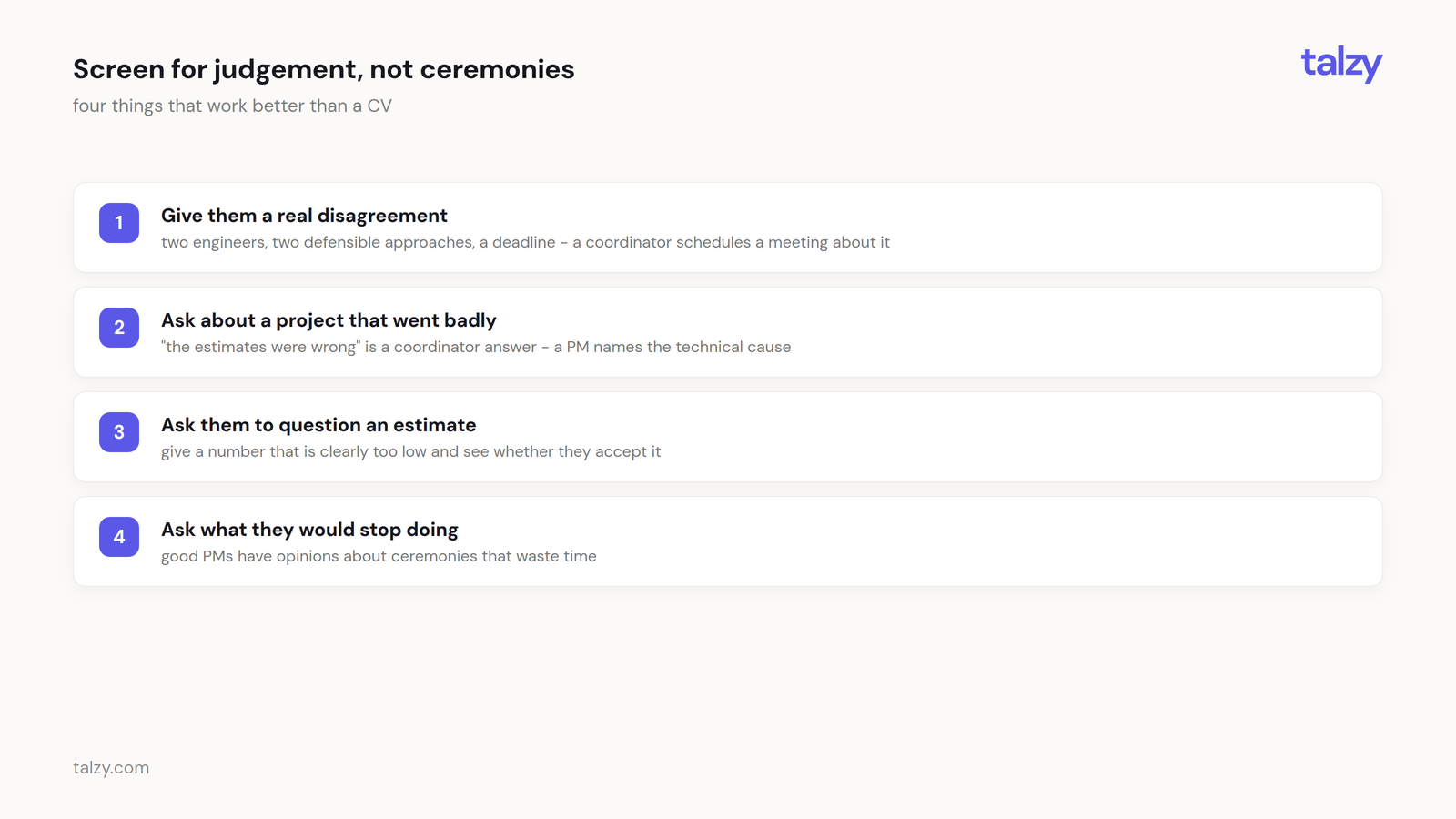
Four things that work better than a CV.
Give them a real disagreement. Two engineers, two approaches, both defensible, and a deadline. Ask what they would do. A technical PM engages - asks what the trade-off is, who is affected, what happens if the wrong one is chosen. A coordinator escalates it or schedules a meeting about it.
Ask about a project that went badly. Everyone has one. Listen for whether they understood the technical cause. "The estimates were wrong" is a coordinator's answer. "We underestimated the migration because nobody had looked at the data quality" is a PM's.
Ask them to question an estimate. Give a feature and a number that is clearly too low. See whether they accept it. A PM who cannot push back on engineers will not protect a deadline; they will only report on it.
Ask what they would stop doing. Good PMs have opinions about ceremonies that waste time. Someone who defends every ritual has not thought about why they exist.
Working across timezones
From Latvia, Lithuania or Poland to the US East Coast there is a working afternoon of genuine overlap. Enough for a real standup, live problem-solving, and the informal conversations where most PM work actually happens.
That matters more for this role than any other. A PM who cannot talk to people in real time is reduced to writing summaries, which is the coordinator job again by another route.
West Coast is harder. It works, and it needs deliberate structure - a fixed overlap window that both sides protect, and a written decision log so the hours without overlap are not blocked.
Who they should report to
Into engineering, not into a separate delivery function.
A PM who reports away from the team they serve ends up representing the reporting line rather than the work. The failure mode is subtle: they become accurate rather than useful, describing problems rather than solving them.
Hiring one, briefly
Decide whether the problem is deciding or delivering. Write the ad for judgement rather than ceremonies. Screen with a real disagreement and a bad estimate. Check timezone overlap is enough for live conversation.
And be suspicious of the smoothest interview. In this role, the person asking harder questions about your architecture is usually the better hire.
Frequently asked questions
Evaluating how to build your European team?
Tell us the role and team size. We'll send an honest read on whether Talzy is the right partner - and if it is not, we'll tell you that too.