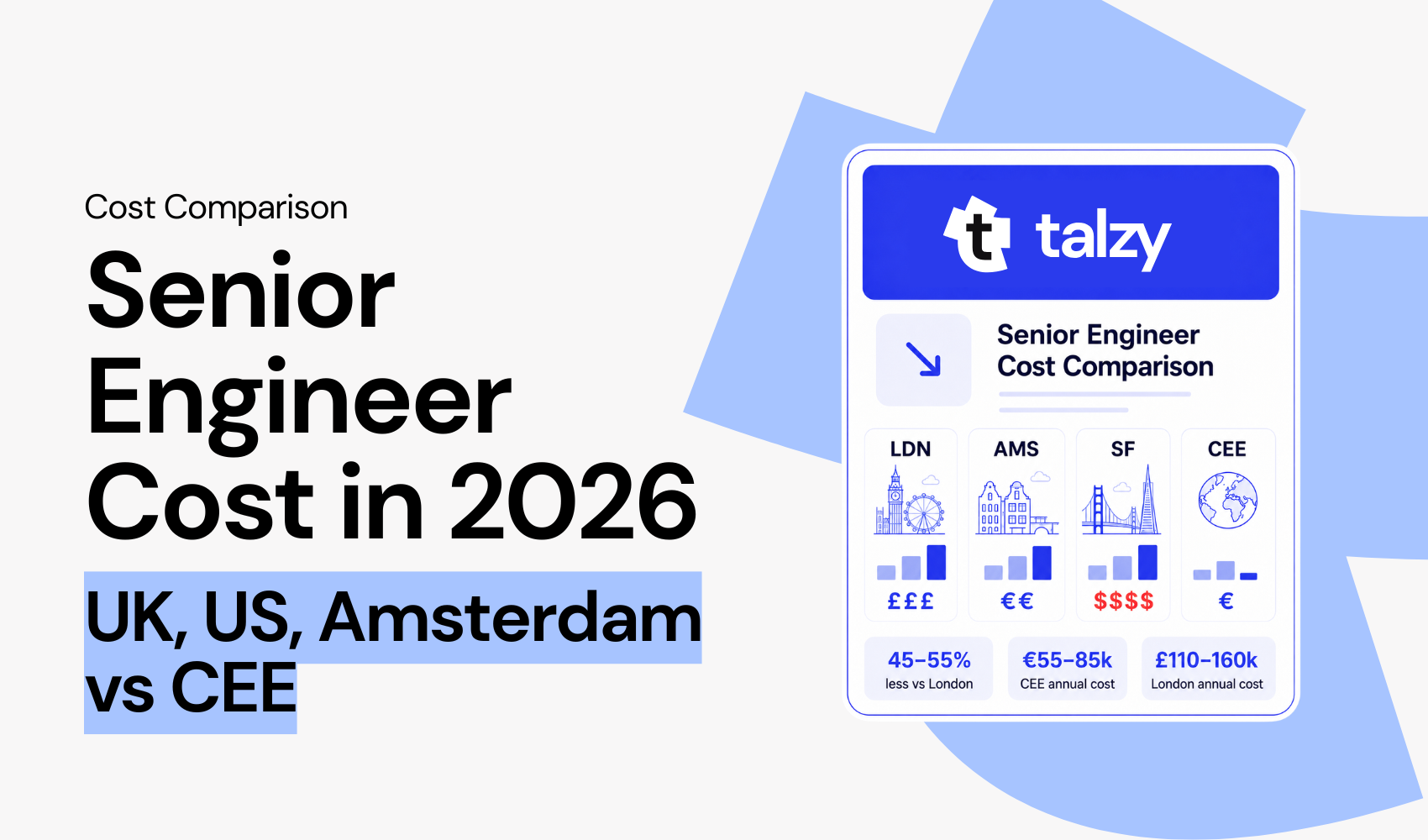
A senior software engineer in London costs £110-160k all-in. In San Francisco, $260-380k. In Latvia, Lithuania, or Poland — €55-85k for the same role. Same skill, half the cost.
You can spend a Series A round on a 10-person London engineering team, or spend it on a 22-person team based in Latvia, Lithuania, or Poland. That is the calculus most Series A and B founders are quietly running right now. This piece breaks down where the numbers come from, what is actually different between an engineer in each city, and the hidden costs no one puts on a job board.
For the inside view — what each CEE country costs vs each other (Latvia vs Lithuania vs Poland), see the companion piece: the 2026 Developer Cost Guide. This article is the outside view — Western markets vs CEE, for buyers who have not yet decided whether CEE belongs in their hiring plan.
The headline numbers — total annual cost to employer
These are cost-to-employernumbers: base salary, bonus, employer-side social charges, and standard benefits. Equity is excluded (it does not compare cleanly across cities). Talzy's fee is included in the CEE column. Numbers refer to the placement ranges Talzy sees in 2026 — verify a specific role on the live cost calculator.
| Role | London | Amsterdam | San Francisco | CEE (LV / LT / PL) | Savings vs London |
|---|---|---|---|---|---|
| Senior Backend | £110-160k | €95-135k | $260-380k | €55-85k | 45-55% |
| Senior Frontend | £100-145k | €85-125k | $240-340k | €50-78k | 45-55% |
| Senior Mobile | £115-165k | €100-140k | $270-390k | €58-88k | 45-55% |
| Senior Data Engineer | £115-160k | €100-140k | $270-390k | €58-88k | 45-55% |
| Senior ML / AI | £140-220k | €120-180k | $320-500k | €70-110k | 50-60% |
| Senior Platform / SRE | £125-180k | €105-150k | $290-420k | €62-95k | 45-55% |
| Senior Embedded | £100-145k | €85-125k | $250-360k | €52-80k | 45-55% |
| Senior Security | £130-190k | €110-160k | $300-440k | €65-100k | 45-55% |
Three things to notice. First, ML / AI engineers are the most expensive everywhere, and the gap between cities is the widest for them — a senior ML hire in San Francisco runs half a million dollars total comp. The same engineer, with the same training-pipeline experience and PyTorch fluency, costs around €100k in Vilnius or Warsaw. For teams hiring ML engineers, the arbitrage is the biggest single line item on the board deck.
Second, the CEE numbers are not a typo. Vinted — a $5 billion Lithuanian unicorn — publishes Senior Backend Engineer salary bands of €4,975-€8,842 per month gross in Vilnius. That is €60-106k per year, and it is the floor of senior engineering comp at one of Europe's most respected tech companies. Wise (now NYSE-listed) and Skype both built their original engineering teams in Tallinn and Vilnius at comparable rates.
Third, the London-Amsterdam gap is smaller than people think. Amsterdam runs roughly 15% cheaper than London for the same engineer. The "EU is cheaper than UK" narrative is true but modest — the real gap opens up only when you go further east.
Methodology
These ranges pull from four sources: Talzy's live placement data across Latvia, Lithuania, and Poland (Talzy has placed 18 engineers, PMs, QA, and support specialists across four client companies as of mid-2026); public salary data from Glassdoor, Levels.fyi, and LinkedIn Salary for UK / NL / US; Vinted's publicly published Vilnius engineering salary bands as the CEE anchor; and our own conversations with hiring managers across the Western and CEE markets.
These are not a single statistically representative dataset. Treat the table as a planning baseline, not a quote. For role-specific live numbers, use the live cost calculator. For the deeper CEE-internal breakdown (Latvia vs Lithuania vs Poland by role and seniority), see the 2026 Developer Cost Guide, which has 60 cells of placement-anchored data.
Why the same role is priced so differently
Four real reasons drive the difference between an engineer in San Francisco and an engineer in Riga. Two are structural and will not change. Two are arbitrage windows you can capture.
1. Local cost of living and tax structure.A senior engineer in San Francisco spends $4,000/month on a one-bedroom. The same engineer in Vilnius spends €700. Pre-tax salaries follow local rent curves. Employer-side social charges also vary wildly: roughly 13% in the UK, 25% in the Netherlands, 31% in Germany, and somewhere between 1.77% (Lithuania) and 23.59% (Latvia) across CEE. Lithuania's anomalously low employer contribution is the single biggest line-item difference for CFOs comparing offers.
2. Equity-heavy comp culture in the US. US engineers expect equity to be a meaningful part of total comp — often 30-40% at VC-backed companies. UK and EU engineers generally do not expect anywhere near that ratio. CEE engineers generally do not expect equity at all. The cash-equivalent value of US senior comp would be closer to $200k if you stripped out equity, but the equity is real money to the engineer and real dilution to you.
3. Supply and demand. San Francisco has roughly 250,000 software engineers in its metro area. London has about 200,000. CEE combined has around 150,000+. CEE engineers are cheaper despite being scarcer because local demand is lower — the local startup ecosystem only has so many seats, and cost of living means engineers do not need US-style salaries. The arbitrage exists because CEE supply is decoupled from your Western demand for it.
4. Information asymmetry. Most CTOs in the US and UK do not know what a CEE engineer actually delivers. They underweight CEE talent because they have never worked with it. This is the real arbitrage — the market has not priced in the quality fully. Vinted, Wise, and Skype have already shipped global products from CEE engineering. The market just has not caught up.
The first two reasons are permanent. The last two are arbitrage windows that are slowly closing as more companies discover the region.
What you are actually buying when you hire a senior engineer
The £160k London senior backend engineer and the €85k Vilnius senior backend engineer are doing the same job — shipping production code, owning a service end-to-end, mentoring more junior engineers, making architecture decisions that do not bite you in 18 months. If you are hiring well, the output is comparable.
Where you will see real differences:
Time zone overlap. A CEE engineer overlaps cleanly with London (one hour ahead), Amsterdam (zero hours), Berlin (zero hours), and the US East Coast (about 4 hours of overlap). They are not ideal for a San Francisco team that wants synchronous standups at 9am Pacific.
English fluency. Universal at L3 and above (what Talzy calls a Senior Developer). Most CEE CS graduates have been working in English since their second year of university, and a meaningful share have already shipped products to US / UK clients before they hit five years of experience.
Engineering culture norms. Closer to Northern European than American. Engineers expect to be trusted with judgment, asked their opinion in architecture conversations, and given time to do something properly rather than rushed.
Risk tolerance.Often lower than what you would see in a senior SF hire. A CEE engineer is more likely to ask "what happens if this fails in production" than to ship a hack and patch it later. This is a feature, not a bug, for fintech, health-tech, infrastructure, and any product where downtime hurts.
The hidden costs no one puts in the job-board number
The salary is the visible cost. The invisible costs are where companies actually lose money. The deeper breakdown lives in the four-ways-to-hire piece — here is the short version.
Recruiting fees. Senior engineering hires in London or Amsterdam routinely cost 20-25% of first-year salary in agency fees. That is £20,000-£40,000 per hire before the engineer has shipped a single commit. In San Francisco, contingent recruiting can run 25-30%. With a CEE staffing partner, recruiting is typically baked into the fee structure — there is no separate £25k bill.
Equity dilution. A senior US engineering hire at a Series A will negotiate for 0.1-0.5% equity. Across 10 hires that is 1-5% of your company gone before you raise Series B. CEE engineers generally do not ask for equity (it is not standard local comp).
Onboarding ramp + retention. A senior engineer takes 60-90 days to be productive anywhere. If your London hire churns at 18 months (the median for London engineering, per a 2025 RippleMatch study), you have eaten the ramp cost twice in two years. CEE median tenure at companies Talzy places at runs closer to 3-4 years.
Relocation.Hiring "remote London" with relocation runs £8,000-£15,000 for moving costs, visas, and temporary housing. Hiring a CEE engineer who stays in CEE: zero relocation cost.
Add it up and a London senior engineer is not really £140k. It is closer to £180-200k effective cost per year, year one. The CEE equivalent stays at €70-85k.
When CEE engineering makes sense (and when it does not)
CEE engineering is a fit when:
- You are at Series A through C and engineering payroll is your biggest line item
- Your CFO has flagged burn rate
- You hire any engineer in London, Amsterdam, Berlin, Paris, or Dublin and would also hire them remote in Manchester, Bristol, or Madrid
- You already work with Polish, Romanian, or Ukrainian engineering teams and want to add quality at the senior level
- Your roadmap is heavy on backend, ML, data, mobile, or platform work
- You need EU GDPR compliance to be native to your engineering team
CEE engineering is not a fit when:
- You need on-site, lab-based hardware engineering (semiconductor, defense, photonics)
- Your code is ITAR-controlled or Five-Eyes-restricted
- You want synchronous overlap with San Francisco mornings
- Your engineering team is currently 1-3 people and you need a Tech Lead in the building daily
For most VC-backed scale-ups in fintech, B2B SaaS, AI / ML, and consumer internet, nearshoring to CEE is a 40-50% cost reduction without a quality compromise — provided you partner with someone who knows the market.
How to think about engineering cost in 2026
Engineering cost is the most important number in your runway model and the most poorly understood. Most CTOs benchmark it against the local market they hire from and never look outside that market. The companies that win the next decade are the ones that treat engineering compensation as a geographic optimization problem, not a fixed local cost.
Latvia, Lithuania, and Poland produced Vinted, Wise, Pipedrive, and parts of Skype and Bolt. The CEE engineering market is not an experiment. It is a 35-year-old ecosystem that until recently was discovered mostly by accident. The arbitrage window is open, and it is open longer than most people think — but it will not be open forever. Apollo's headcount data shows a 38% year-over-year increase in non-CEE companies hiring engineers based in Latvia, Lithuania, and Poland in 2025-2026.
If you are hiring a senior engineer in London or SF at full price in 2026, you should know exactly why. The comparable engineer is available for half the cost — and the only thing stopping you from accessing them is whether you have taken the time to look. The next step is how Talzy works, or start the conversation and we will send an honest read on whether CEE belongs in your team build.
The cheapest senior engineer is not the one with the lowest salary. It is the one whose fully-loaded cost — recruiting, ramp, equity, retention, relocation — pencils best against the work they actually ship. For most Western teams in 2026, the math points to CEE.