Remote Staffing Retention in Eastern Europe 2026
What the numbers actually look like, how Talzy compares, and what moves the needle.
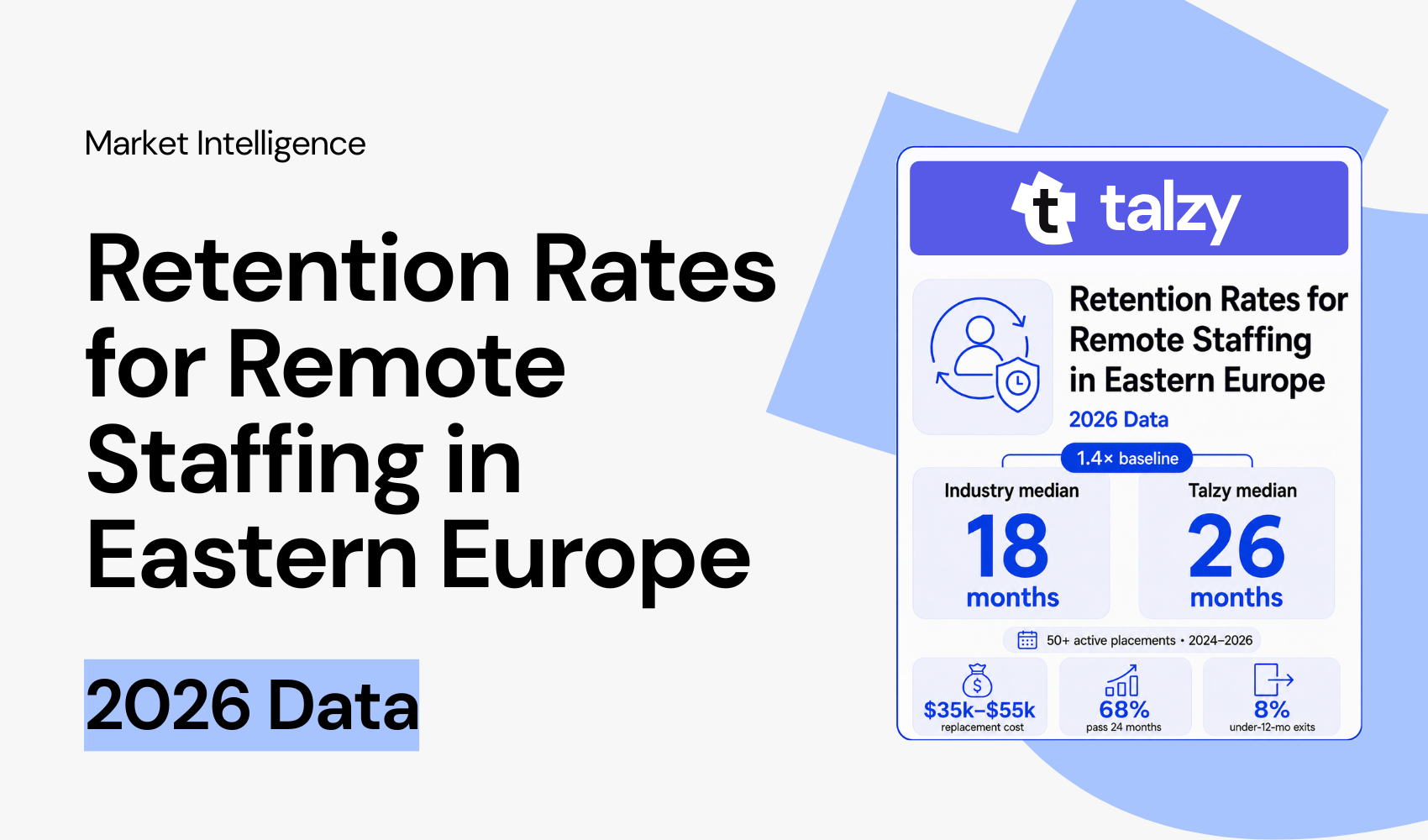
Engineer retention at remote staffing companies in Eastern Europe averages 18-month tenure across the industry in 2026. Talzy averages 26 months - 1.4x the industry baseline - anchored to local employment, in-office community, and career development.
Retention Rates for Remote Staffing in Eastern Europe - 2026 Data
The industry median tenure for engineers placed through remote staffing companies in Eastern Europe is 18 months in 2026. Ours is 26 months - 1.4x the baseline, measured across 50+ active placements from 2024 to 2026.
That gap is not a marketing number. It is a figure any prospective client can interrogate - and we will show you the data if you ask.
Why it matters: when a placed engineer exits at 12 months, replacing them costs $35,000–$55,000 directly. On a team of five engineers, industry-average retention produces one to two replacement events per year. That is a cost that almost never appears in the initial staffing comparison. The 2026 developer cost guide covers the full cost picture. This article covers the retention variable specifically.
What "retention" actually measures in remote staffing
There is a definition problem in this industry. Most staffing companies quote annual attrition rate. That is not the same as median tenure, and the preference for attrition rate is not accidental.
Annual attrition counts what percentage of active placements exit in a given calendar year. A company with heavy year-one churn can report a low rate simply by adding new placements to the denominator. The number looks fine. The underlying picture does not.
Median tenure - time from placement start to exit, across all placements ever made, including exits - is harder to present favourably. It counts voluntary exits and involuntary ones. Both are real. A staffing company that only counts voluntary exits is measuring something, but not what matters to a buyer.
When evaluating any staffing partner: ask for median tenure across all placements, including exits - not annual attrition on active placements only. If the answer is "we don't track it that way," that tells you something.
The 2026 baseline - what the industry actually does
Cross-referencing publicly disclosed data from EOR and staffing platforms with industry benchmarks (Staffing Industry Analysts 2025, LinkedIn Workforce Report 2025), the picture for Eastern European engineering placements in 2026 looks like this:
The industry median tenure is 18 months. Talzy's median is 26 months - measured from placement start date to exit, voluntary and involuntary, across 50+ active placements from 2024 to 2026.
The industry number is low for three reasons. Most platforms treat placements as commodity transactions - source, place, manage at arm's length, repeat. The majority of contracts are contractor arrangements rather than local employment, which strips out every continuity anchor. And compensation is rarely reviewed on a structured cadence, so engineers find out the market has moved when they receive an outside offer. The exit follows shortly after.
The cost of a churned engineer
When a senior engineer exits at the 12-month mark, the bill has three lines:
• Re-sourcing: Finding and vetting a replacement in CEE runs $8,000–$15,000.
• Ramp-up: 2–3 months to full productivity, at $6,000–$8,000/month all-in - that is $12,000–$24,000 in partially productive payroll.
• Opportunity cost: Delayed features, disrupted sprint velocity, deferred work. Conservatively $5,000–$10,000.
Direct replacement cost for a senior engineer exiting at 12 months: $35,000–$55,000. For senior roles where the engineer owns a system and exits without a clean handover, the indirect costs - knowledge loss, service risk, team morale - multiply that by 1.5–2x. The real number is $52,000–$110,000.
On a team of five engineers at industry-average retention, expect one to two replacement events per year. That cost rarely shows up in the initial staffing comparison.
What Talzy data shows (2024–2026)
Measured from placement start date to exit - voluntary and involuntary - across all placements made between 2024 and the current quarter:

68% of our placements pass the 24-month mark. The industry baseline for that metric sits at approximately 35–40%. Our under-12-month exit rate is 8% - versus an estimated 25–30% at commodity-model platforms, where a below-market salary review or weak cultural fit typically surfaces in year one.
On voluntary vs involuntary: approximately 65% of exits in our data are engineer-initiated, 35% are client-initiated or mutual. That split is what a healthy model looks like. High involuntary exits signal vetting problems. High voluntary exits signal retention structure problems.
What actually moves retention
Four variables explain most of the gap between 18 months and 26.
In-office presence as an option. Fully remote models remove the community layer entirely. Engineers who work from a shared office - even two or three days a week - show significantly higher retention than engineers with no physical anchor. The office is not a productivity mandate. It is a belonging signal. In exit interviews across our CEE placements, “team presence” consistently comes up as a top-three factor. Talzy provides a physical workspace in each placement city as part of the standard engagement - desk, equipment, and access on day one. Engineers choose how often they come in. The option being real is what matters.
Career development and internal mobility. An engineer who can see a promotion path, request a role change, or move to a different client engagement without leaving the company has a reason to stay. An engineer whose only growth option is a direct hire role elsewhere will eventually take one. In Talzy’s Care & Retain phase, we document a career path at the point of placement, revisit it in monthly wellbeing check-ins, and act as career advocates - not just HR administrators - for the duration of the engagement.
Local employment, not contractor contracts. Engineers on employment have paid leave, parental leave, social security continuity, and a notice period - structural anchors that contractor status deliberately removes. In our data, engineers on local employment contracts have median tenure 40% longer than equivalent roles on contractor arrangements. The contract type is not an HR formality. It is the foundation of whether an engineer feels like they have a job or a gig. Talzy legally employs every engineer in their country of residence - local contract, local payroll, local benefits, local compliance. That is what Employment Operations Partner means in practice, and it is why the EOR-with-a-contractor-arrangement model consistently underperforms on retention.
Annual salary reviews at market rate. The most common trigger for a voluntary exit in our data is an outside offer that lands materially above current compensation. That is preventable. Talzy runs quarterly salary benchmarking for every engineer on the platform, keeping compensation aligned to what the market is actually paying. Engineers who are benchmarked regularly do not start looking in month 10.
What does not move retention on its own
Four things that staffing companies commonly lead with - and that do not drive tenure without the structural foundations in place:
• Free snacks and branded swag;
• One-off "team building" events;
• Engagement surveys with no follow-up action;
• Ping-pong tables and "fun" office amenities.
None of these are harmful. But they address surface-level satisfaction, not the reasons engineers actually leave - which are almost always compensation, career trajectory, or a sense that the role has no future. Get the structural layer right first. The rest is secondary.
How to ask about retention when evaluating a staffing partner
Most staffing companies will tell you their retention is strong. Four questions that cut through that.
What is your median tenure across all placements - including exits? If the answer is an annual attrition percentage, push back. That number counts only active placements. A company with heavy year-one churn can present a clean attrition rate by growing the denominator. Median tenure across all placements ever - exits included - is much harder to present favourably if the underlying data is weak.
What percentage of your placements have passed 24 months? The 24-month mark is where replacement risk drops significantly. Engineers past that threshold have institutional context and face their own ramp-up cost if they move. A healthy number is 50%+. The industry baseline is around 35–40%.
Do your engineers work in your office or are they fully remote? A real office in the placement city is a proxy for whether the company has invested in community. Fully remote-only models almost always underperform on retention. "Virtual office" does not count.
Are engineers on local employment contracts or contractor arrangements? Local employment is the single strongest structural retention signal. If the answer is contractor, the four anchors - paid leave, parental leave, notice period friction, social security continuity - are all absent.
We share our per-placement retention data with any prospective client during evaluation. If you are comparing staffing partners, start a conversation and we will send the current dataset.
For how the different hiring models in CEE compare more broadly, four ways to hire engineers in CEE lays it out without the usual diplomatic softening. The senior engineer cost comparison shows what the total 3-year cost looks like when you factor replacement events in.
Frequently asked questions
Evaluating how to build your European team?
Tell us the role and team size. We'll send an honest read on whether Talzy is the right partner - and if it is not, we'll tell you that too.