How to Hire Developers in Poland in 2026 - Cost, Talent Pool, and Employer Tax Map
The deepest engineering pool in CEE, what it actually costs, and the three traps to avoid when hiring in Poland.
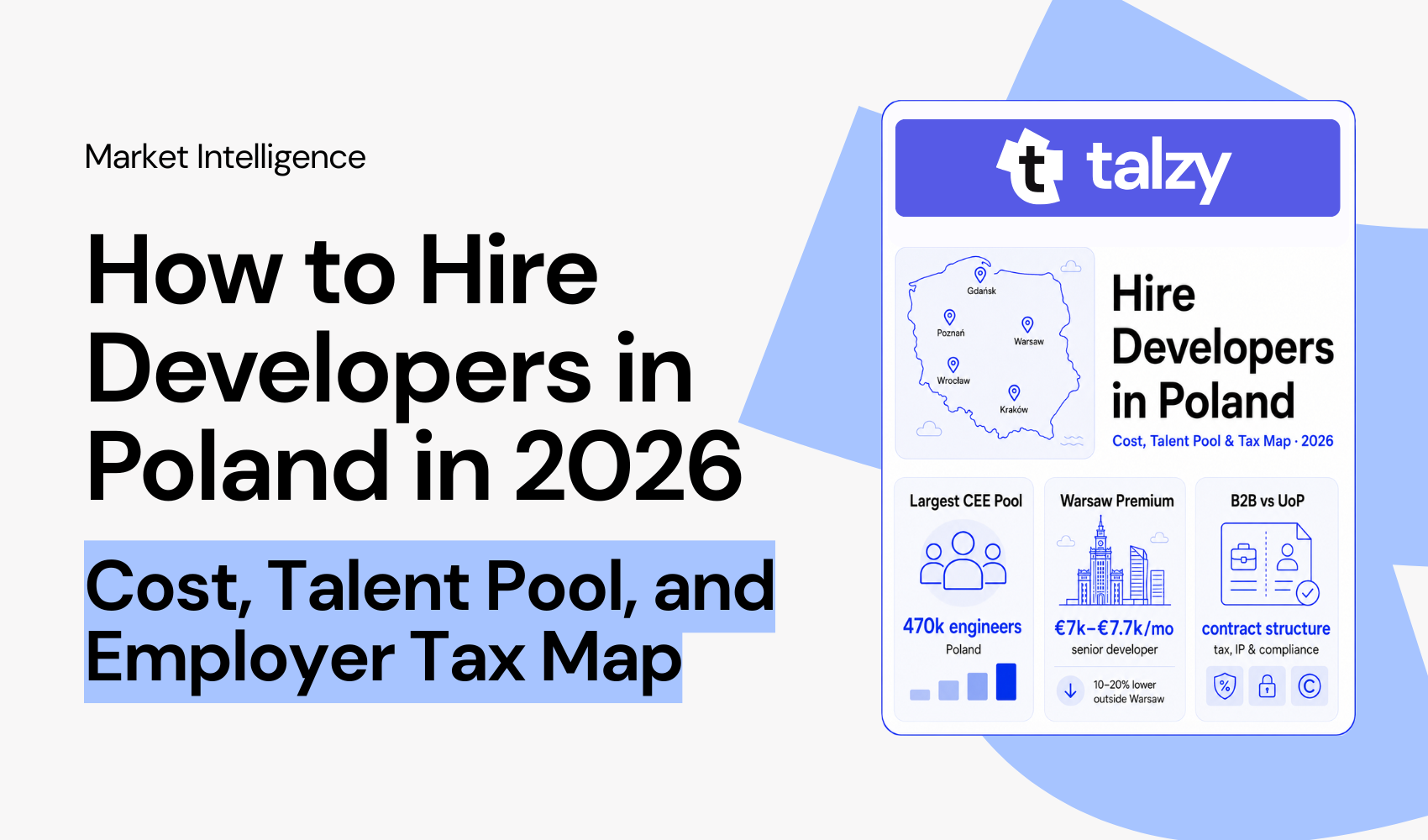
Hiring a senior developer in Warsaw in 2026 costs €7,000–€7,700/month all-in. Kraków, Wrocław, and Gdańsk offer 10–20% cost savings with comparable senior depth in specific stacks.
Poland has approximately 470,000 active software engineers in 2026 - the largest engineering pool in CEE by a significant margin. A Warsaw-based senior developer costs €7,000–€7,700/month all-in, and 10–20% less in Kraków, Wrocław, or Gdańsk with no meaningful compromise on seniority for most stacks. But Poland also has a contract structure that trips up most foreign companies on first contact: the B2B versus employment (UoP) split, which affects employer cost, IP ownership, tax liability, and termination rights in ways that are not obvious until they are already a problem. This article covers all of it - cost by city, stack depth, contract mechanics, and where the traps are. To hire developers in Poland effectively, you need to understand the market before the search starts.
Why Poland is the deepest engineering pool in CEE
The scale difference between Poland and the rest of CEE is not marginal. Poland has roughly five times the number of active software engineers as Latvia and Lithuania combined. That depth shows up in every dimension of the hiring process: wider shortlists, faster sourcing timelines, more speciality depth, and more cities with viable senior pools across multiple stacks.
Three structural reasons explain the pool depth. First, the university pipeline. AGH University of Science and Technology in Kraków, Warsaw University of Technology, Wrocław University of Science and Technology, and Poznań University of Technology collectively graduate more than 25,000 engineering and computer science students per year. The pipeline has been producing at this volume for over 20 years, which means the senior level bench is deep - not just the junior one.
Second, the enterprise software and outsourcing history. Poland has been a destination for Western European and North American software development since the early 2000s. That means a generation of senior engineers who have worked in English, shipped production software for international clients, and built the professional habits that make remote collaboration work. English proficiency at senior level is consistently higher in Poland than in most Eastern European markets.
Third, the fintech and product company wave. The last decade has produced a cohort of Polish-born product companies - Allegro, Docplanner, Brainly, Packhelp - that have trained engineers in genuine product engineering rather than outsourcing delivery. Those engineers are now on the market and bring product ownership experience that agency-trained engineers often do not.
The 2026 cost map by city
Fully loaded monthly cost - gross salary, employer contributions, and Talzy service fee covering HR, legal, compliance, office, and admin. Not the gross salary alone. Warsaw is the most expensive city in the Polish pool, and the most commonly quoted benchmark. The non-Warsaw cities are consistently 10–20% cheaper for comparable seniority in most stacks. For the full CEE cost comparison, see the 2026 senior engineer cost breakdown for UK/US vs CEE.
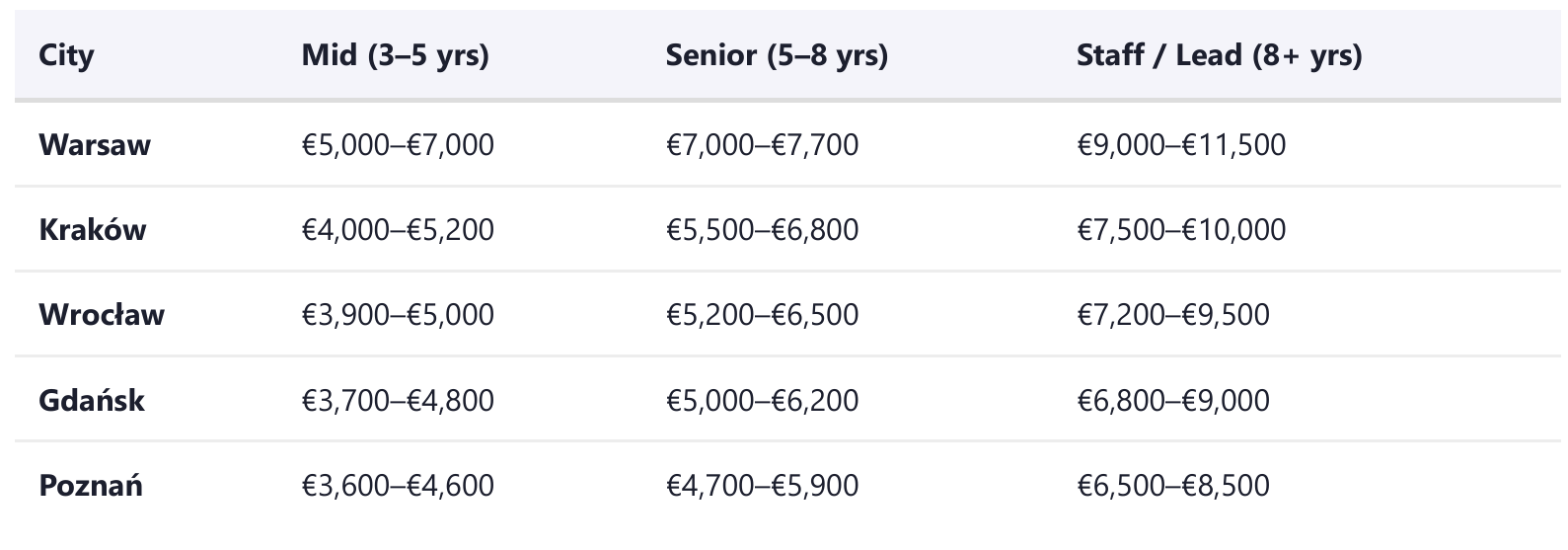
A note on what drives the Warsaw premium: it is not purely salary expectations. Warsaw has the highest concentration of Western European and North American company offices in Poland, which has pushed the market rate up through competition. An engineer in Kraków with the same skills and seniority as one in Warsaw will typically cost 10–15% less - not because they are less experienced, but because the market they are pricing themselves into is less competitive. For a team of five senior engineers, that delta adds up quickly. For current live placement numbers, see the Talzy pricing calculator.
B2B contract vs full employment contract - the foreign-company trap
This is the section most foreign companies skip when they first hire in Poland. It is the one that causes the most problems.
Polish engineers work under one of two contract types. Understanding both is non-negotiable before you make a hire.
Full employment contract - full employment. The engineer is a formal employee. The employer pays approximately 22% in social contributions on top of gross salary. The engineer accrues paid annual leave (20–26 days), sick leave entitlement, and has the protections of the Polish Labour Code - including notice periods of up to 3 months for long-tenured employees. IP created during the employment relationship belongs to the employer by default. This is the structure most foreign companies want, and the one that creates the clearest employment relationship.
B2B - self-employed contractor. The engineer operates through their own sole trader company and invoices the client monthly. Employer-side social contributions: effectively zero. No statutory paid leave. No sick leave liability. Termination is straightforward - end the service agreement. IP ownership requires explicit contractual language. This is the structure most Polish engineers want, because the Polish tax system creates significant net-pay advantages for self-employed individuals versus salaried employees.
The friction: what engineers want and what foreign companies want are often different. Most senior Polish engineers prefer B2B - sometimes strongly. Many foreign companies want UoP because it provides cleaner IP assignment, clearer employment relationship, and fewer contractor misclassification risks. The tension is real and needs to be addressed explicitly in the hiring process, not after an offer is made.
The misclassification risk. The Polish tax authority enforces the distinction between genuine B2B and disguised employment aggressively. If an engineer working on a B2B contract is found to be operating as a de facto employee - same hours, single client, no independence - the tax authority can reclassify the arrangement, resulting in back-payment of social contributions plus penalties. Foreign companies without Polish legal counsel routinely underestimate this risk
How Talzy handles this: we employ engineers on UoP contracts through our Polish entity in Warsaw. You get the employment wrapper, the IP clarity, and the compliance assurance - without needing your own Polish entity or navigating the B2B vs employment decision yourself. The engineer receives market-competitive net pay. The foreign company does not carry the misclassification risk.
Where the senior bench actually sits by stack
Poland is the deepest engineering pool in CEE, but depth is not uniform across stacks or cities. Here is the realistic picture:
Java - the deepest single-language pool in Poland, and arguably in all of CEE. Spring Boot engineers are plentiful across Warsaw, Kraków, and Wrocław. Kraków in particular has a concentration of senior Java engineers driven by the financial services and enterprise software companies that have operated there for over a decade. If you need to hire backend developers with strong Java experience, Poland is where the search should start.
Python - deep and growing. Strong in Warsaw and Wrocław, solid in Kraków. The data engineering and ML-adjacent Python pool is concentrated in Warsaw. Backend Python (Django, FastAPI) is well-distributed across all five cities.
.NET - deep in Kraków and Wrocław, strong in Warsaw. Poland's .NET bench is the strongest in CEE after Latvia's, driven by the same enterprise software wave that built the Java pool. If your stack is .NET-first, Kraków and Wrocław are often underrated relative to Warsaw.
Go - emerging but Warsaw-concentrated. The senior Go pool outside Warsaw is thin. Plan for a longer search and a smaller shortlist for any Go role outside the capital.
Frontend (React, Vue, Next.js) - deep across all five cities. Poland has one of the strongest frontend benches in CEE. React and Next.js depth is particularly strong in Warsaw and Wrocław. To hire frontend developers in Poland, shortlists are consistently achievable in all five cities for React and Next.js roles.
Data engineering - deep in Warsaw and Wrocław, growing in Kraków. The Spark, dbt, and Airflow proficient senior data engineer pool is concentrated in the larger cities. Smaller cities have data engineering talent but narrower senior depth at the 5+ years level.
The three traps when hiring Polish engineers
Trap 1: Misclassifying a B2B contractor as an employee. Covered above, but worth repeating: the Polish tax authority enforces this distinction aggressively. A foreign company running a B2B arrangement that looks like employment - fixed hours, single client, no genuine business independence - is exposed to reclassification, back-contribution payments, and penalties. Get Polish legal counsel before structuring any B2B arrangement. Or use a partner with a Polish entity who handles this for you.
Trap 2: Underestimating the Q4/Q1 hiring slowdown. Poland has a heavy concentration of public holidays in November and December, plus a cultural norm of extended Christmas breaks. Most Polish engineers are genuinely unavailable for interviews or offer consideration from mid-December through the first week of January. Starting a Polish search in November with the expectation of a January start is a plan that fails reliably. The best hiring windows are February–May and September–November. If you need a January start date, begin the search in October.
Trap 3: Assuming all of Poland is Warsaw-priced. The Warsaw rate card is what most candidates quote, what most outsourcing agencies bill at, and what most foreign companies assume when they budget a Polish hire. Kraków, Wrocław, Gdańsk, and Poznań are consistently 10–20% cheaper for comparable seniority in most stacks - and for Java, .NET, and Python specifically, the quality of the non-Warsaw shortlist is not materially weaker. If your budget is tight, specifying city flexibility in the search brief costs nothing and opens the shortlist significantly.
Hiring in Poland through Talzy
We operate a Polish entity with direct employment infrastructure in Warsaw. Engineers are employed on UoP contracts through our Polish company - which means you get full employment structure, IP clarity, and compliance assurance without setting up your own entity or navigating the B2B vs employment decision.
Timeline: 2–4 weeks from kickoff to signed offer for a senior backend or frontend role in Warsaw. Narrower stacks - Go, Rust, Elixir - run toward the longer end of that range.
The vetting sequence runs: a code review exercise against a representative codebase, a structured technical screen, and a C1 English gate before a candidate reaches your desk. We source, screen, and shortlist - your team does the final interview and makes the call. Read more about how we vet candidates in our Hire Senior Backend Developers in CEE guide.
RECENT PLACEMENT - ANONYMISED
A Series B SaaS company needed a senior Java engineer in Warsaw to own backend architecture for a payments integration layer. 3 weeks, 14 candidates screened, 2 through final interview. Placed a Warsaw based engineer - 7 years experience, Spring Boot and Kafka, prior fintech product work. Fully loaded: €7,500/month. London equivalent for the same profile: £11,000–£13,500/month.
Setting up your own Polish entity makes sense at roughly 15+ engineers - below that, the legal, HR, and accounting overhead is not worth it. We support the entity graduation path for clients who reach that threshold. To hire developers in Poland through Talzy, or to understand which contract structure makes sense for your team, start a conversation.
Frequently asked questions
Evaluating how to build your European team?
Tell us the role and team size. We'll send an honest read on whether Talzy is the right partner - and if it is not, we'll tell you that too.