Hire Senior Backend Developers in CEE - 2026 Talent Map
What it costs, where the senior bench actually sits, and how to vet for it.
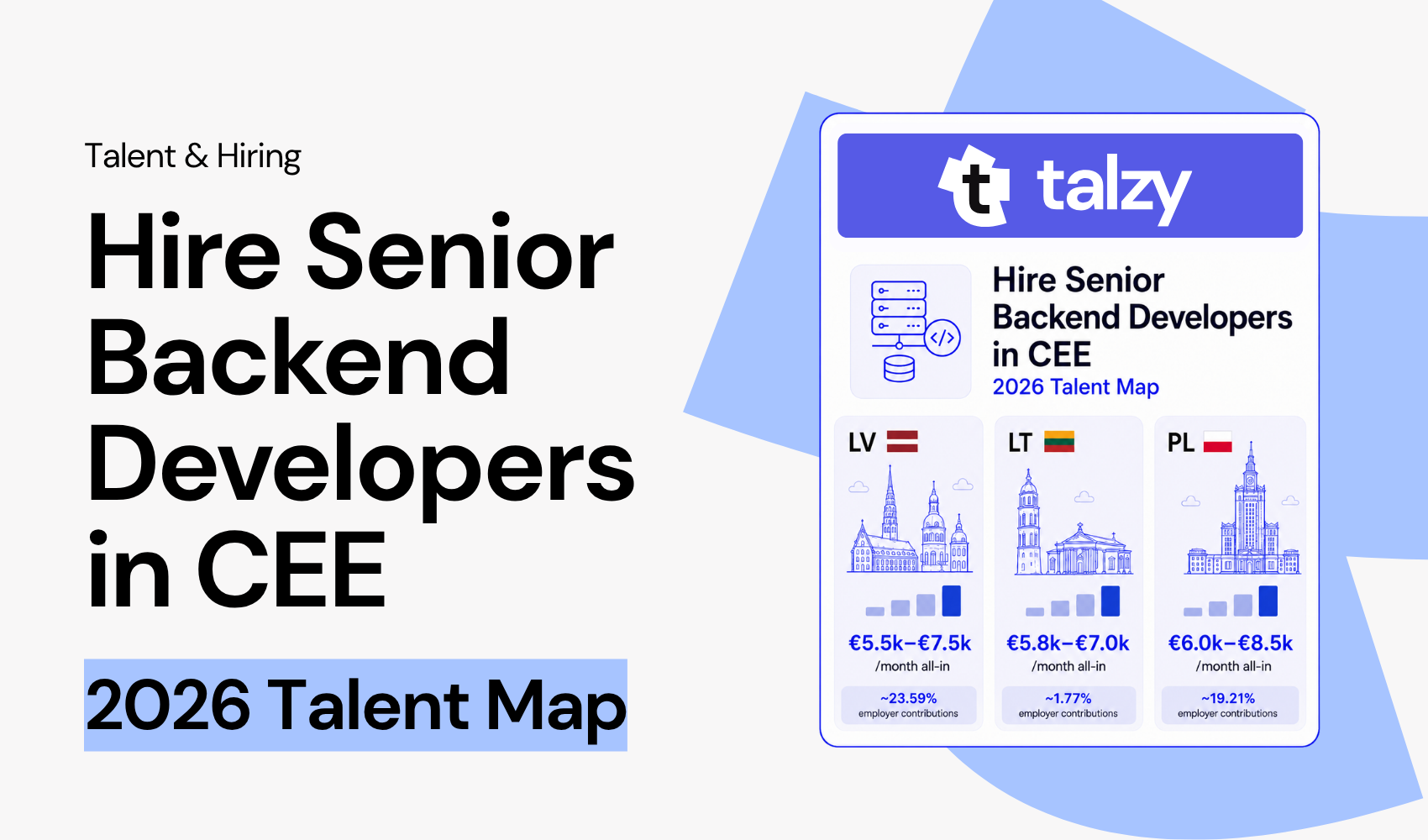
A senior backend developer in CEE (Latvia, Lithuania, Poland) costs €5,500–€8,500/month all-in in 2026 - roughly half of London or NYC for comparable skill, with the largest senior bench in Poland.
Hire Senior Backend Developers in CEE - 2026 Talent Map
A senior backend developer in Latvia, Lithuania, or Poland costs in 2026 €5,500–€8,500/month all-in - fully loaded, gross salary plus employer contributions plus workspace and management overhead. That is roughly 45–55% of an equivalent hire in London or New York, with the widest gap at the senior end rather than entry level. If you are looking to hire backend developers for a growth-stage team, CEE is the region where that combination of seniority, pool depth, and cost lands most reliably - but only if you know which country to hire in, which stack to search for, and what the vetting process should actually look like.
What "CEE" means for backend hiring in 2026
When Talzy uses "CEE" in the context of engineering hiring, it means three countries: Latvia, Lithuania, and Poland. Estonia is deliberately excluded - we do not operate there, and lumping the Baltics together as a single market misrepresents the real geography. Romania and Bulgaria are on the radar but outside our operating footprint in 2026.
These three markets are not interchangeable. Poland is roughly five times the size of Latvia and Lithuania combined - it has the deepest pool, the most city-to-city cost variation, and the most established English-language engineering culture. Lithuania sits in the middle on pool depth and has a structural quirk in its employer contribution structure that consistently trips up North American finance teams when they first see the invoice. Latvia is the smallest market but has disproportionately strong .NET and Python depth relative to its size, and - in our observation - the highest retention rates of the three.
Why these three and not broader Eastern Europe? Pool depth, salary level, and employer law are the three variables that make a remote engineering market workable at scale. Romania and Ukraine have depth but different risk profiles. The Balkans have cost advantages but materially thinner senior pools in most backend stacks. Latvia, Lithuania, and Poland are where a growth-stage company can build a team of 3–15 senior backend engineers with predictable timelines, predictable all-in cost, and a legal employment structure that works - without setting up an entity in a market you do not fully understand yet. For a broader look at what the cost picture across all three markets looks like at every role and seniority level, the 2026 developer cost guide covers Latvia, Lithuania, and Poland in full.
The cost stack - €5,500–€8,500/month all-in (2026)
The number that circulates in LinkedIn discussions and outsourcing sales decks is almost always a gross salary number. That is the wrong number to plan against. The actual all-in cost has four components:
• Gross salary - the number the engineer sees on their payslip before personal income tax.
• Employer social contributions - mandatory payroll taxes paid by the employer ontop of gross salary. These vary significantly by country (more below).
• Workspace and equipment - desk, laptop, peripherals, software seats. Whether these are bundled into a service fee or line-itemed separately, they are real costs.
• Management overhead - account management, HR operations, payroll administration, and any local entity costs associated with keeping the employment running.
In practice, the all-in ranges for a senior backend engineer (5+ years, solid system design skills, C1 English) across the three markets break down as follows:
| Country | Gross salary /month | Employer contributions | All-in/month (est.) |
| Latvia | €3,700–€4,600 | ~23.59% on gross | €5,500–€7,500 |
| Lithuania | €3,600–€4,400 | ~1.77% on gross | €5,800–€7,000 |
| Poland | €3,800–€5,800 | ~19.21% on gross | €6,000–€8,500 |
The wide range within each country reflects the difference between mid-senior (5–7 years) and deep senior (8+ years, architecture-level), between cities, and between stacks. A Python engineer in Warsaw commands a different number than a .NET engineer in Riga. For current, role-specific numbers, see our pricing calculator - it reflects live placement data updated quarterly.
Why Lithuania's employer line looks lower than it is
Lithuania's 1.77% looks like a typo next to Latvia's 23.59%. It is not. Lithuania moved most social contributions onto the employee side in 2019 - so the employer pays almost nothing on top of gross salary. The engineer's gross in Lithuania is close to what they would earn in Latvia, but your invoice looks dramatically different.
This is the structural quirk that catches many first-time CEE buyers. You see similar gross salaries across Latvia and Lithuania, assume the cost is comparable, and miss the contribution gap entirely. Lithuania ends up materially cheaper for the employer at senior level - not because of salary, but because of what sits on top of it.
Latvia is a different story. Gross salaries are the lowest of the three markets - but employer contributions are the highest at 23.59%. The total cost lands higher than Lithuania as a result. What Latvia offers instead is retention. Across our Latvian placements, churn sits under 8% annualised - well below the CEE average. For teams where stability matters more than squeezing the monthly invoice, Latvia often makes more sense than the cost comparison alone suggests.
Where Poland's cost shows up (Warsaw vs other)
Poland's salary ranges span the widest of the three markets. Warsaw commands a consistent premium of 15–25% over Kraków, Wroclaw, and Gdansk across every role and seniority level. For a senior backend engineer specifically, that means Warsaw lands at €7,900–€9,900/month all-in versus Kraków or Wroclaw at €7,000–€8,800/month all-in - a €900–€1,100/month delta per engineer that compounds quickly at team scale.
The non-Warsaw Polish cities are not a compromise on talent quality. Kraków has deep Java and Python depth - strong enough that you will find a comparable shortlist to Warsaw, just with a slightly longer sourcing window. Wroclaw is strong in frontend and Python. Gdansk and Poznan have smaller pools but can work for specific stacks, particularly .NET.
Where the senior bench actually sits - by stack
Not every backend stack has the same depth in CEE. Knowing this before you start the search saves 3–6 weeks. Here is an honest read on each major stack across Latvia, Lithuania, and Poland:
Python - the deepest pool in CEE, full stop. Strong senior bench across all three countries, with Django, FastAPI, and Flask all well-represented. Data-engineering Python is thinner than pure backend Python - the senior data engineers with production pipeline experience at scale are harder to find - but for backend API and service work, Python is where you will have the widest shortlist and the fastest timeline.
Java - deepest in Poland, and specifically in Warsaw, Kraków, and Wroclaw. Spring Boot engineers are plentiful across the Polish market. Latvia and Lithuania have solid mid senior Java depth but a narrower shortlist at the very senior end. If your Java requirement is architectural - design patterns, microservices at scale, cross-team tech leadership - Poland gives you the most options and the highest probability of a 4–6 week placement.
Node.js - consistent across all three countries. Senior Node.js with TypeScript is easy to source in Riga, Vilnius, and Warsaw alike. Often combined with React knowledge on the frontend side, which matters if your backend engineers are expected to occasionally touch the frontend layer.
.NET - Latvia and Poland strong, Lithuania thinner. Latvia has disproportionately deep .NET expertise for its market size - a legacy of enterprise software companies headquartered in Riga. Poland's Warsaw and Kraków also run deep. Lithuania has .NET engineers but the pool is narrower at Senior+ level. If .NET is your primary stack and you have flexibility on country, Latvia is worth considering despite its smaller overall market.
Go - growing fast, but the pool is still narrow. Most senior Go engineers in CEE are concentrated in Warsaw and Vilnius. Outside those two cities, you are typically looking at 2–4 genuinely strong candidates in the active market at any given time. Plan for a 2–3 week longer sourcing timeline than you would expect for Python or Java, and expect a shorter shortlist. If Go is your only stack and you need to hire three engineers, Poland (Warsaw) is your best single bet.
Rust, Elixir, Clojure - these exist in the CEE pool, but we are being direct: you are looking at 1–3 strong candidates who are actively open to a move at any given time, not 30. A Rust search in CEE is a different exercise than a Python search - it is closer to a targeted headhunt than a sourcing funnel. If your architecture genuinely requires one of these, the search will take longer and the shortlist will be shorter. A hybrid approach - hiring a senior engineer with adjacent skills and a demonstrated track record of picking up new languages - is often the more realistic path.
How to vet backend engineers remotely - Talzy's process
Remote vetting is where most companies cut corners, and where most bad hires happen. A CV screen and a 45-minute technical call are not enough to confirm senior-level readiness. Here is the process we run for every backend placement:
1. CV and portfolio screen - through the Talzy platform. Every candidate is matched against your role's stack and seniority markers (complexity of systems worked on, not just years), GitHub or production work where available, and English written communication quality assessed from the application itself. This runs on AI-assisted sourcing across our CEE pipeline plus direct outreach - we are not waiting for inbound applications, we are building the shortlist.
2. A 30-minute call with the candidate. This is where you meet the engineer directly - using your own interview framework, or one we provide if you would rather not build one from scratch. It is the moment to check technical depth, communication under real-time conditions, and culture fit, and to confirm that the person on the call matches what is on the CV. By this stage, the candidate has already cleared Talzy's structured technical interview and English screen - only shortlisted candidates reach you.
3. Code review exercise - scoped to your needs. Depending on the role and how your team works, this can be a take-home exercise or a live session in which the engineer reviews a piece of intentionally imperfect code. Where useful, this reveals code quality standards, attention to detail, and whether the engineer can communicate technical feedback clearly - the skill that matters most when they are reviewing junior work on your team. We scope this step with you per placement rather than running it as a fixed, one-size-fits-all exercise.
4. Reference calls - minimum two, from direct managers or senior peers rather than colleagues chosen by the candidate. We ask specifically about delivery reliability, communication quality, and how the engineer handles disagreement with technical decisions they did not make.
Common red flags that come up in this process: engineers who perform well in a structured interview but cannot sustain async written communication at pace; engineers who are genuinely senior in one narrow stack but overstate breadth; engineers whose references confirm technical quality but flag collaboration friction. None of these would surface from a CV and a single call.
The full hiring model comparison - including how this vetting process fits into the four main ways companies build CEE engineering teams - is covered in four ways to hire from Eastern Europe.
Three pitfalls people fall into
These are the mistakes we see most often from companies hiring backend engineers in CEE for the first time - or from companies that have tried once, had a bad experience, and are unsure what went wrong.
Pitfall 1: EOR platforms with no vetting - the "you hire, we pay" trap. Employer of Record services like Deel and Remote solve one real problem - the legal employment wrapper in a country where you do not have an entity. They do not solve sourcing, vetting, or retention. If you use an EOR platform and source the engineer yourself, you are taking on the full vetting risk with none of the local relationship infrastructure that makes retention predictable. The result is often a hire that looks good on paper, works at a mediocre level for 9–12 months, and then churns - leaving you to restart the process. The EOR does not have skin in the engineering quality game; only a partner who owns both the legal structure and the sourcing funnel does.
Pitfall 2: Agency markup chains - cost compounds 25–40% per layer. The CEE recruitment market has layers. A recruiter finds a candidate, passes them to a staffing agency, who passes them to a local EOR, who bills the client. Each layer adds margin. By the time the invoice arrives, a senior engineer whose gross salary is €4,500/month costs the client €9,000–€11,000/month all-in - which is comparable to a London hire, without the proximity advantage. The multi-layer structure also makes accountability opaque: when something goes wrong with the engineer's performance, there is no single point of contact who owns the problem. For more on this cost comparison, see our breakdown of senior engineer cost UK vs CEE.
Pitfall 3: Rate cards that hide infrastructure cost. The quoted "all-in" number from many staffing providers excludes workspace, equipment, software licences, and management overhead. These lines are real - they add €300–€500/month per engineer - and they appear on the invoice eventually, just not on the slide in the initial sales presentation. Always ask: does this rate include the engineer's desk, laptop, and software tools? Does it include account management and HR operations? If the answer is "we can discuss that separately," you have found the hidden cost.
When CEE backend is the right call (and when it isn't)
CEE backend hiring is not the right move for every team at every stage. Here is an honest guide to when it works well and when it does not.
Fewer than 10 engineers total - CEE works well here if you have at least one strong technical person internally who can onboard, direct, and review the work. The engineers are senior, but they still need context and technical leadership. A team where the first external hire is also the first person who has written production code is a difficult setup anywhere.
10–50 engineers - the strongest fit for CEE. Enough scale that the cost difference is meaningful, enough team infrastructure that the new engineers land into something. This is where the combination of pool depth (particularly in Poland and Lithuania) and all-in cost savings creates the clearest business case.
50+ engineers - CEE remains viable but the coordination overhead of a large distributed team becomes a real management variable. At this scale, companies typically consider whether to set up their own entity in Latvia, Poland or Lithuania, which shifts the economics and the operational model. We cover the entity graduation path for clients who reach this point - hire software developers covers the different structures available.
When NOT to use CEE backend hiring:
• Hyper-niche stacks with almost no regional pool - if you need a principal Erlang engineer or a Zig specialist, the CEE pool is not the answer. The search becomes a global headhunt regardless of geography.
• Deeply local domain knowledge - if the role genuinely requires deep familiarity with US healthcare billing systems, Australian financial regulation, or UK public sector procurement, the domain context is the bottleneck, not the technical skill. CEE engineers can learn domain knowledge but it takes time; if you need someone operational in 4 weeks, hire locally.
• FedRAMP, ITAR, or equivalent compliance constraints - some US government or defence-adjacent contracts require that engineering work is performed by US citizens or in specific jurisdictions. CEE hiring is incompatible with these constraints by definition.
If you are unsure which category your situation falls into, the clearest path is a short conversation. Start a conversation with us and we will give you an honest read - including if the answer is "CEE is not the right move for you right now."
Frequently asked questions
Evaluating how to build your European team?
Tell us the role and team size. We'll send an honest read on whether Talzy is the right partner - and if it is not, we'll tell you that too.