Hire QA engineers in CEE
What good QA actually costs, where the bench is, and how to tell a tester from a QA engineer
QA is the role US teams cut first and regret fastest. A QA engineer in Latvia, Lithuania or Poland costs roughly half a US equivalent, and the bench is deeper than for backend because fewer companies compete for it. The main hiring mistake is screening for tools instead of thinking.
QA is the role US teams cut first and regret fastest. A QA engineer in Latvia, Lithuania or Poland costs roughly half a US equivalent, and the bench is proportionally deeper than for backend because far fewer companies compete for it. The main hiring mistake is screening for tools instead of thinking.
We place QA engineers alongside developers, usually as staff augmentation, and it is consistently the role clients underestimate until they have one.
Why QA gets cut, and why that is expensive
The logic is always the same. The developers can test their own work, we are moving fast, we will add QA later.
What follows is also always the same. Developers test the path they built, because that is the path in their head. Nobody tests the interaction between two features written by different people. Bugs reach customers, and each one costs a context switch for whoever built it, an apology from support, and a fix that jumps the queue.
The cost never appears as a QA line item. It appears as engineers being slower than they should be, and nobody connects the two.
Tester or QA engineer
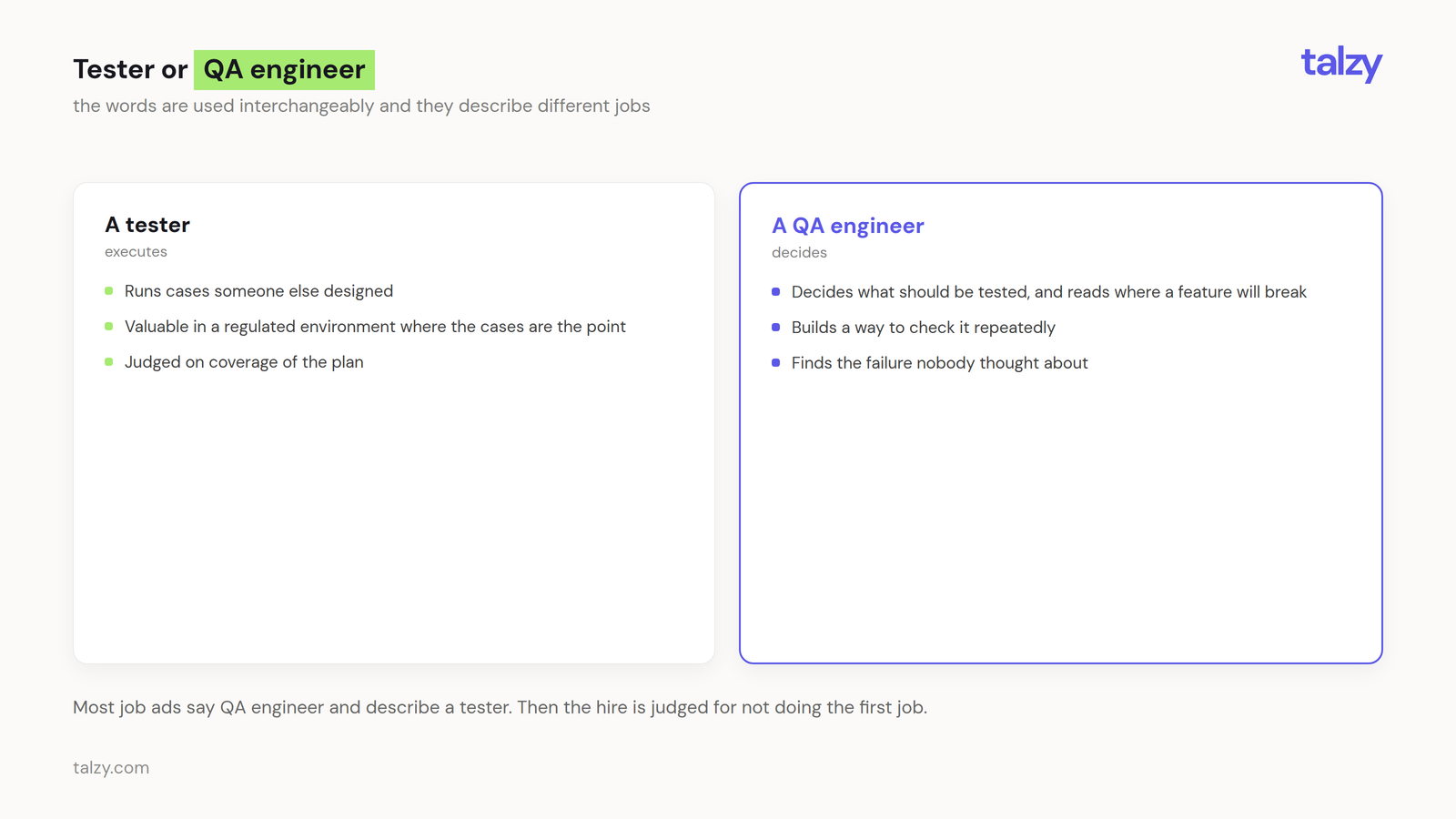
The words are used interchangeably and they describe different jobs.
A tester executes cases someone else designed. Valuable in a regulated environment where the cases are the point.
A QA engineer decides what should be tested. They read a feature, work out where it is likely to break, build a way to check that repeatedly, and find the failure nobody thought about.
Most job ads say QA engineer and describe a tester. Then the hire is judged for not doing the first job.
Decide which you want before writing the ad. If the answer is "someone who tells us what is risky", you want the engineer, and you should expect to pay for one.
Manual or automation
If you only hire one, hire automation.
A good automation engineer does manual testing when manual is right - exploratory work, a first pass on new UI, anything where the cost of automating exceeds the value. A manual tester cannot build a regression suite.
The hire that goes wrong is a manual tester brought in to "eventually automate". Automation is a different skill, closer to development, and eventually rarely arrives.
What you want in practice is someone who can write a maintainable suite in whatever your stack already uses, and who knows which tests are worth writing. The second half matters more. A thousand brittle tests that fail randomly are worse than fifty that people trust.
The bench in CEE
Latvia, Lithuania and Poland have a large software industry and a QA discipline that grew alongside it - product companies, outsourcing firms and financial services all built serious QA functions.
The practical advantage is competition. Every company on the continent is chasing senior backend engineers. Far fewer are hiring QA, so good people are more reachable, respond to approaches, and are not fielding four other offers.
Poland has the largest pool. Latvia and Lithuania are smaller but strong in fintech and product QA, and the market is less picked over.
How to vet one remotely
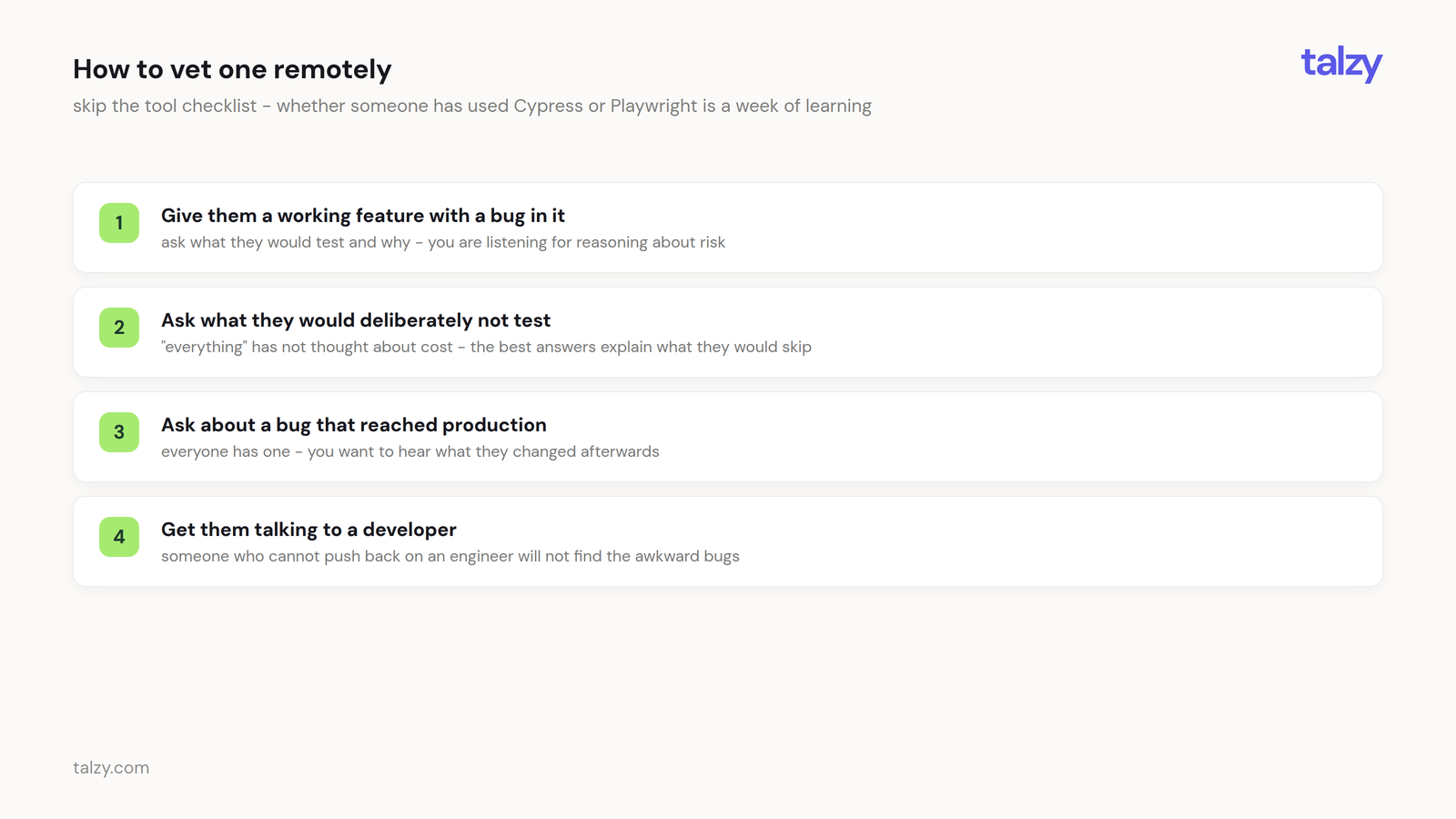
Skip the tool checklist. Whether someone has used Cypress or Playwright is a week of learning, not a hiring criterion.
Give them a small working feature with a bug in it. Ask what they would test and why. You are looking for how they reason about risk - what could break, what would matter if it did, what they would check first.
Ask what they would deliberately not test. The best answers here are unmistakable. Someone who says "everything" has not thought about cost. Someone who explains what they would skip and why understands the job.
Ask about a bug that reached production. Not to catch them out - everyone has one. You want to hear what they changed afterwards. Good QA engineers have opinions about process, not just cases.
Get them talking to a developer. QA works only if the relationship works. Someone who cannot push back on an engineer, or who does it badly, will not find the awkward bugs.
Where they should sit in your team
Embedded in the development team, not in a separate QA department reporting elsewhere.
Separate QA departments create a hand-off, and hand-offs create the batch-and-queue behaviour that slows everything down. Embedded QA sees the feature while it is being built and catches the design problem before it is code.
Practically: same standup, same sprint, same definition of done, and involved in refinement rather than told what shipped.
What to expect in the first three months
Month one they will find a lot, including things that have been broken for a while and everyone stopped noticing. This is uncomfortable and it is the job working.
Month two the flow settles and they start building whatever automation is worth having.
Month three you notice that fewer things reach customers, and it becomes hard to prove the QA hire caused it - which is the permanent political problem with the role, and worth knowing about in advance.
If you are hiring one
Decide tester or engineer. Decide manual or automation, and probably choose automation. Vet for reasoning about risk, not for tools. Embed them in the team.
And expect the first month to be noisy. That is not a bad hire, it is the backlog you already had, becoming visible.
Frequently asked questions
Evaluating how to build your European team?
Tell us the role and team size. We'll send an honest read on whether Talzy is the right partner - and if it is not, we'll tell you that too.