Hire ML Engineers in CEE - Where the Senior Bench Sits in 2026
What a senior ML engineer costs across Europe, the realistic CEE bench depth by speciality, and how to vet for production-grade ML.

A senior ML engineer in CEE costs €6,000–€8,500/month all-in in 2026 - roughly half of London. Warsaw and Vilnius have the deepest production-ML benches; Riga has the strongest research leaning and LLM pool.
A senior ML engineer in CEE costs €6,000–€8,500/month all-in in 2026. The same profile in London runs £140,000–£180,000/year fully loaded - roughly double. Warsaw has the largest absolute ML pool in CEE. Vilnius punches above its size in MLOps and fintech-adjacent production ML. Riga has a concentrated research and LLM ecosystem built around the University of Latvia and Tilde. If you are looking to hire machine learning engineers for a production team, the CEE picture is more nuanced than the backend market - pool sizes are smaller, speciality matters more, and vetting for production readiness versus research experience is the single most important call you will make before posting the role.
“ML engineer” in 2026 is at least four different roles
Most job posts say “ML engineer.” Most hiring managers mean something different from each other. This gap causes more bad hires in ML than in any other engineering discipline - because the profiles look similar on a CV and are completely different in practice. There are four meaningfully distinct profiles under the title.
Production ML engineer. Ships models into production, deals with serving infrastructure, monitors model performance in the real world, and debugs the gap between what the model does in a notebook and what it does at 3am under load. This is the role most growth-stage companies actually need. It is also the hardest to vet for, because notebook performance is easy to fake and production ownership is not.
MLOps engineer. Builds the platform that lets ML engineers ship reliably - model registry, training infrastructure, feature stores, CI/CD for ML, observability. Closer to DevOps than to data science. For most teams under 30 ML engineers, a dedicated MLOps hire is premature. Above that scale, it becomes the unlock that makes the rest of the team faster.
Research-leaning ML engineer. Runs experiments, reads papers, implements novel architectures, pushes the state of what the model can do rather than the reliability of how it runs. Right for companies with a genuine research moat. Wrong for companies that need models shipped, not improved.
LLM application engineer. Builds on top of foundation models - RAG pipelines, agents, prompt scaffolding, evaluation frameworks. The fastest-growing segment in 2024–2025, now normalizing in 2026 as supply has grown to meet demand. Cost: roughly 85–95% of a traditional senior ML engineer right now.
Define the day-to-day before the search starts. What does this person own in the first 90 days? Is the primary bottleneck getting models into production, keeping them there reliably, improving their quality, or building on top of existing foundation models? That answer determines which profile you need - and which vetting signals apply.
Where the senior ML bench actually sits in CEE
The ML pool in CEE is smaller than the backend or frontend pool. Being honest about that upfront saves weeks. Here is the realistic picture by city.
Warsaw - the largest absolute ML pool in CEE. Strong depth in production ML and LLM application engineering. Warsaw benefits from a concentration of fintech, e-commerce, and enterprise software companies that have been running production ML for 5+ years - which means engineers with real production scars, not just experimentation history. If you need volume - multiple ML hires at once - Warsaw is the only CEE city where that is consistently achievable.
Vilnius - strongest in MLOps and fintech-adjacent production ML. The same companies (Nord Security, Vinted, Revolut Lithuania) that built the DevOps bench in Vilnius also built a production ML and MLOps cohort. Smaller pool than Warsaw but higher average seniority at the senior+ level. If you need someone who has owned ML infrastructure at a regulated financial product, Vilnius is where to look. See talzy.com/insights for more on the Lithuanian engineering market.
Riga - the strongest research-leaning and LLM pool in CEE relative to pool size. The University of Latvia’s Institute of Mathematics and Computer Science, combined with Tilde (a long-running NLP and machine translation company), has produced a cohort of engineers with genuine research depth - particularly in NLP, language modelling, and low-resource language ML. If your product involves language understanding or generation at a deeper level than LLM API wrappers, Riga is underrated. Talzy sources all research-leaning ML profiles from Riga.
Kraków and Wrocław - production ML depth is growing, driven by the same enterprise software and fintech wave that built the backend pool in those cities. Not yet at Warsaw depth but worth including in a search if the Warsaw shortlist is thin for a specific speciality.
The 2026 cost map
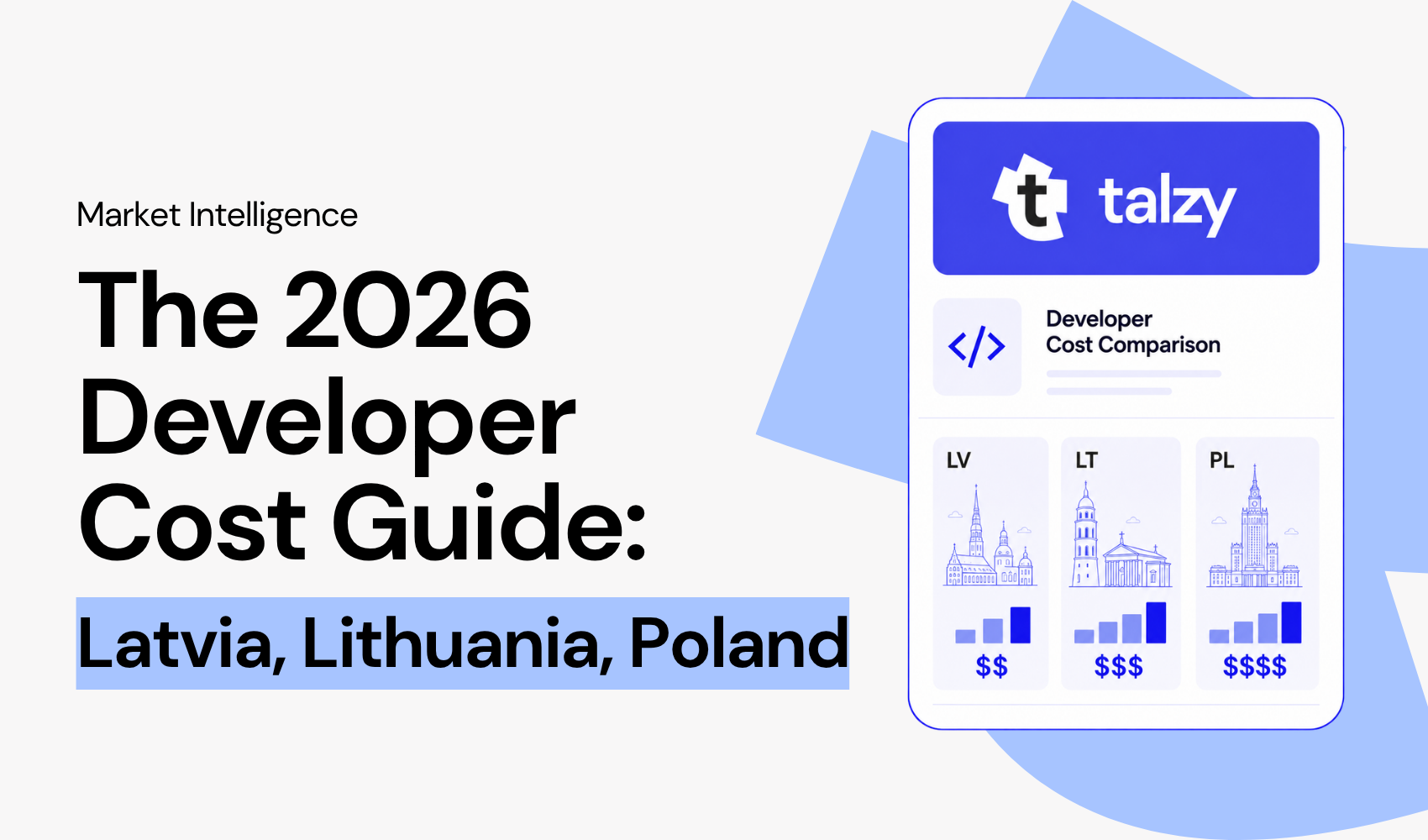
Fully loaded monthly cost - gross salary, employer contributions, Talzy service fee (HR, legal, compliance, office and equipment). Ranges reflect 2026 market rates in each city. For your specific role and seniority, use the live Talzy pricing calculator. For the full cost methodology, see the 2026 developer cost guide.

ML engineers cost more than backend engineers at the same seniority level - typically 15–25% more in CEE. The gap reflects a smaller talent pool, higher demand, and the fact that genuinely production-ready ML experience is rarer than the CV volume suggests. An engineer who has trained models is not the same as an engineer who has run models in production at scale. The former is common. The latter commands a premium.
LLM application engineers currently cost about 85–95% of traditional senior ML. That premium compression happened through 2025 as supply caught up with demand. It may widen again if frontier model capabilities create new LLM product categories faster than engineers can skill up.
The headline comparison: a senior ML engineer in London costs £140,000–£220,000/year fully loaded (£11,700–£18,300/month). The equivalent profile in Warsaw costs €70,000-€110,000/year (€5,800–€9,200/month). Same production ML experience - same PyTorch, same Kubernetes, same ability to own a model failure at 3am - at a 50–60% saving versus London.
How to vet for production-grade ML - not just "I trained a notebook"
Most ML interview processes test model knowledge. Production ML readiness shows up somewhere else. Four signals that separate engineers who have shipped production ML from engineers who have done a lot of Kaggle:
1. They can describe their model’s full lifecycle in production. Ask them to walk through the last model they shipped - from training data to serving endpoint to monitoring. A production engineer describes the serving infrastructure, the retraining trigger, the monitoring metrics, and what broke first. An engineer with only experimentation experience describes training accuracy and validation loss. The gap is immediate.
2. They have an opinion on model serving. Ask: “How did you serve your last model, and would you make the same call today?” A senior production ML engineer has worked with at least one serving stack - Triton, vLLM, BentoML, SageMaker, TorchServe - and has formed views on the trade-offs: latency vs throughput, batching behaviour, GPU utilisation, cold start cost. An engineer who has only trained models will give a vague answer about “deploying to an API.”
3. They have owned latency and cost as metrics, not just F1 score. Model quality is necessary but not sufficient in production. Ask: “What was the p95 inference latency of your last production model, and what did you do to improve it?” A production engineer has a specific answer. An engineer who has not shipped production ML will not know the number - because they never had to care about it.
4. They can describe a failure mode of their own model that they fixed. This is the most revealing signal. Ask: “Tell me about a time your model failed in production in a way that surprised you.” Senior production ML engineers have a specific story - data distribution shift, a feature that behaved differently in prod than in training, a serving bottleneck that appeared under real traffic. Engineers without production experience either cannot answer or describe a training failure, not a production one.
These four signals fit into a 30-minute structured interview run by your team. Add a short take-home exercise - ask candidates to review a model card for a hypothetical production system and identify the risks - and you have a vetting process that filters out most of the notebook-to-CV gap. Talzy runs a parallel vetting sequence before your interview: a code review exercise, a structured technical screen against these four signals, and a C1 English gate. Read more in our Hire Senior Backend Developers in CEE guide.
LLM application engineers vs traditional ML engineers
Most companies building AI products in 2026 need one of these two profiles - and the CVs look similar. In practice they are solving completely different problems.
Traditional ML engineer - owns the model. Trains it, improves it, serves it reliably in production. The hard problems are data quality, training stability, serving latency, and distribution shift. Right for you if your product’s differentiation depends on a model that behaves differently from anything available off-the-shelf.
LLM application engineer - owns the application layer on top of foundation models. Does not train the model. Builds RAG pipelines, agent workflows, evaluation frameworks, and the product logic around foundation model calls. Right for you if you are building on GPT-4o, Claude, Gemini, or open-source models and the bottleneck is in the retrieval, the evaluation, or the reliability of the application - not the model itself. This is most AI product companies in 2026.
On cost: LLM application engineers run at about 85–95% of traditional senior ML in CEE right now. The premium from 2024 has compressed as supply caught up. Close enough that cost should not drive the decision between the two profiles.
The diagnostic question: is the bottleneck in the model, or in what the model is connected to? That answer tells you which one you need. If you are unsure, start a conversation with Talzy and we will help you identify which profile fits.
Hiring ML through Talzy
Talzy places ML engineers across Warsaw, Vilnius, and Riga. Production ML and LLM application engineering are the deepest parts of our pool. MLOps is available primarily through Vilnius. Research-leaning profiles - particularly NLP and language modelling - we source from Riga.
The full placement model follows Talzy’s five-phase process: Define → Source & Vet → Hire & Employ → Equip & Onboard → Care & Retain. Each engineer is employed by Talzy’s local entity, operates from Talzy’s workspace in their city, and is supported by monthly wellbeing check-ins and quarterly salary benchmarking - the model behind our 26-month median retention rate. No entity setup, no local payroll complexity. See our pricing page for the full cost structure.
The vetting sequence runs: code review exercise against a representative ML codebase, structured technical screen using the four production signals above, and a C1 English gate. Before we write the brief, we run a 30-minute calibration call with your hiring manager so the sourcing is targeted from day one. We source, screen, and shortlist - your team does the final interview and makes the call.
RECENT PLACEMENT - ANONYMISED
Series B document intelligence company. Needed a senior production ML engineer to own their extraction pipeline end-to-end: retraining cadence, serving on GCP, and monitoring for distribution shift. Searched across Warsaw and Vilnius, 16 candidates screened, 3 through final interview. Placed a Warsaw-based engineer - 6 years experience, prior production NLP at a fintech processing regulatory documents, strong on TorchServe and model monitoring. Fully loaded: €8,200/month. London equivalent: £13,500–£16,000/month.
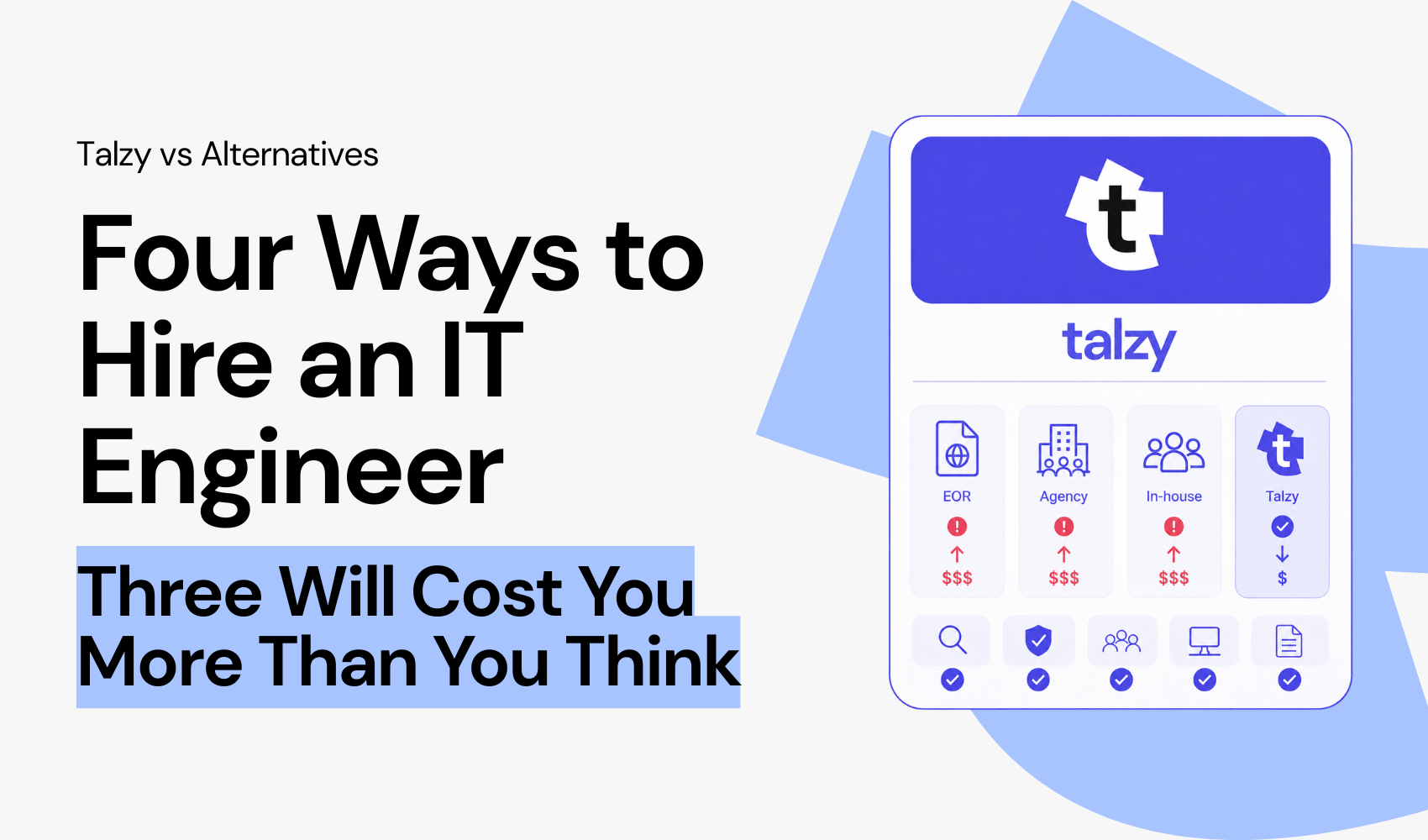
If you are building out frontend alongside ML, the frontend developers in Europe guide covers the same markets. For the full hiring model comparison, see four ways to hire engineers from CEE.
Start a conversation and we will tell you honestly whether the ML speciality you need is in our pool in your timeline.
Frequently asked questions
Evaluating how to build your European team?
Tell us the role and team size. We'll send an honest read on whether Talzy is the right partner - and if it is not, we'll tell you that too.