Hire Frontend Developers in Europe: Cost + Vetting
What a senior frontend engineer costs across Europe, where the React/Vue/Angular benches sit, and how to vet for staff+ frontend skill.
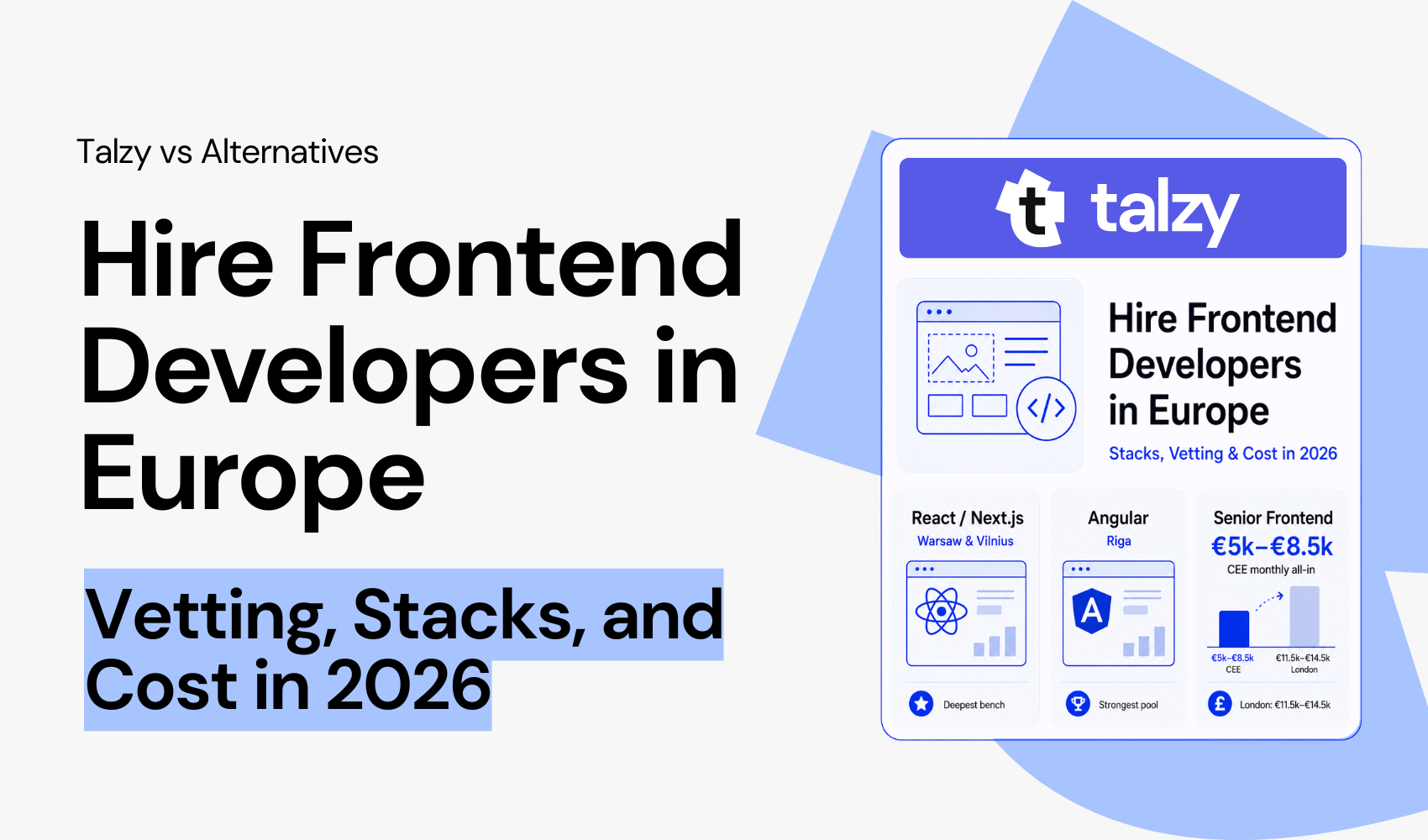
A senior frontend developer in CEE (Latvia, Lithuania, Poland) costs €5,000–€8,500/month all-in in 2026 - half of London, with deep React and Next.js benches in Warsaw and Vilnius, and the strongest Angular pool in the region in Riga.
Hire Frontend Developers in Europe - Vetting, Stacks, and Cost in 2026
A senior frontend developer in CEE costs €5,000–€8,500/month all-in in 2026. The same profile in London runs €11,500–€14,500/month. The deepest React and Next.js benches in Europe sit in Warsaw and Vilnius - and Riga carries the strongest Angular pool in the region, built up over a decade of enterprise software development. If you are looking to hire frontend developers for a product team, this guide covers where the bench is, what it costs, how to vet for actual senior craft, and when an in-house hire beats a development partner.
“Frontend developer” in 2026 means three different roles
Most job posts say “frontend developer.” Most hiring managers mean something different from each other. Getting this wrong before the search starts costs 6–8 weeks and a hire that does not fit.
There are three meaningfully different profiles under the same title.
UI engineer. Owns the component library, the design system, and accessibility. Thinks in tokens, variants, and WCAG. Works closest to design. Does not want to touch the backend and should not be asked to. If your product has a complex design system or a compliance-grade A11y requirement, this is the role.
Product engineer (frontend-leaning). Ships features end to end - enough backend to be dangerous, but the frontend is the home. Works well in companies where engineers own the full stack of a feature from API to UI. The most commonly hired of the three profiles, and the most commonly miscast.
Staff frontend. Architecture decisions, performance ownership, the person who decides what the frontend platform looks like for the next two years. Design partner, not just design consumer. Rare. Usually only the right hire once you have 5+ frontend engineers who need someone setting the direction. Hiring staff-level before you need it is expensive and demoralizing for both sides.
Define the day-to-day before you write the job post. What does this person own in the first 90 days? What does their week look like? That description determines which of the three you actually need - and which vetting signals to look for.
The 2026 cost map
Fully loaded monthly cost - gross salary, employer contributions, workspace and equipment. Not the gross salary alone. For the full cost methodology, see the 2026 developer cost guide.
| City | Mid (3–5 yrs) | Senior (5–8 yrs) | Staff (8+ yrs) |
| London | €8,500–€10,500 | €11,500–€14,500 | €15,000–€20,000 |
| Amsterdam | €8,000–€10,000 | €10,500–€13,500 | €14,000–€18,500 |
| Berlin | €6,000–€8,000 | €8,500–€11,000 | €11,500–€15,000 |
| Warsaw | €4,800–€6,500 | €6,500–€8,500 | €9,000–€12,000 |
| Vilnius | €3,700–€5,000 | €5,000–€6,500 | €7,500–€10,000 |
| Riga | €3,700–€5,200 | €5,200–€6,500 | €7,000–€9,500 |
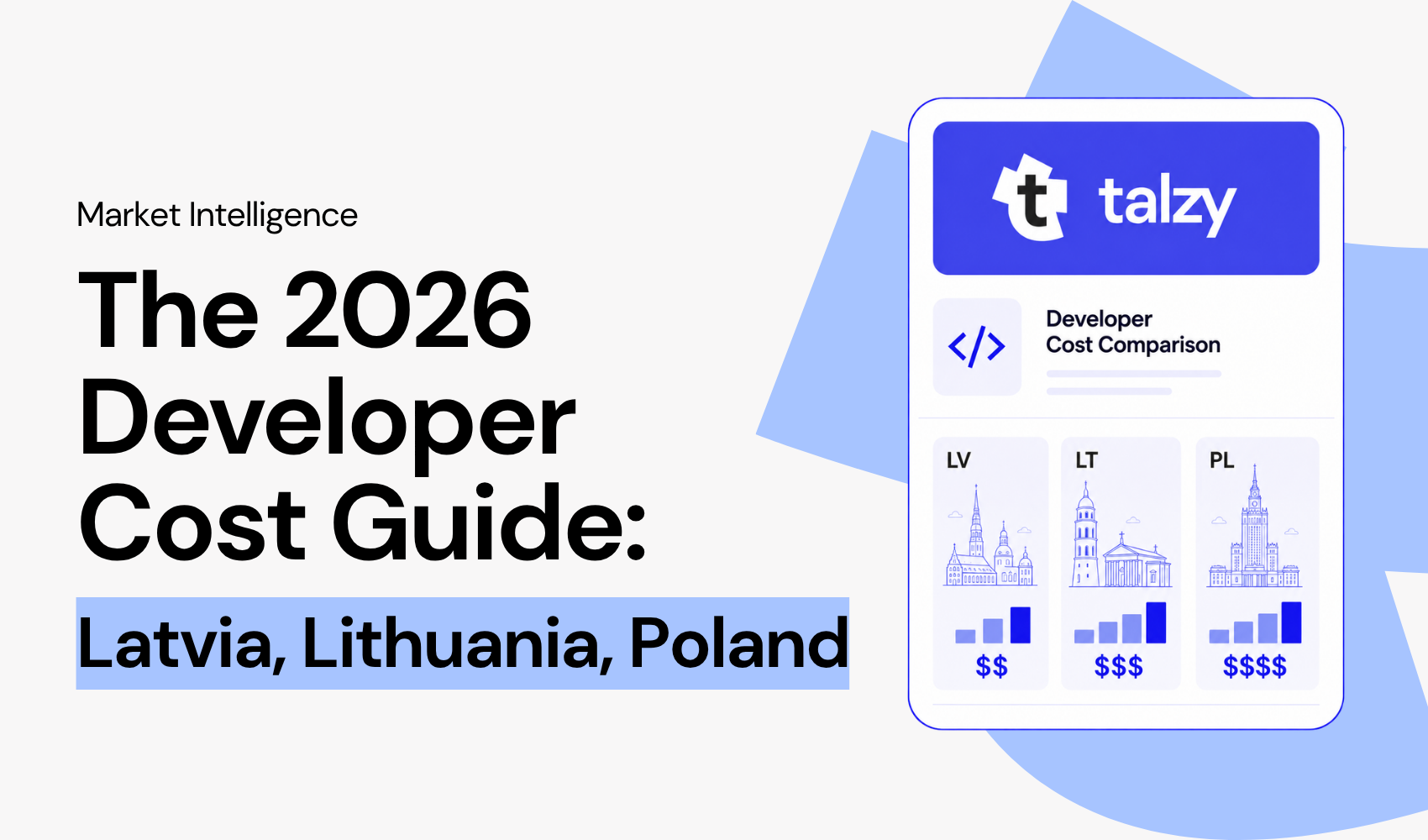
The CEE delta versus Western Europe is 45–55% at senior level and has not narrowed in 2025 or 2026. Riga sits at the lower end of the CEE range and is particularly cost-competitive for Angular and enterprise-grade frontend roles. For current numbers from live placements, see Talzy pricing.
Where stacks have the deepest bench
Not all frontend stacks are equally hireable in every market. Before you start a search, knowing where the bench actually sits saves weeks.
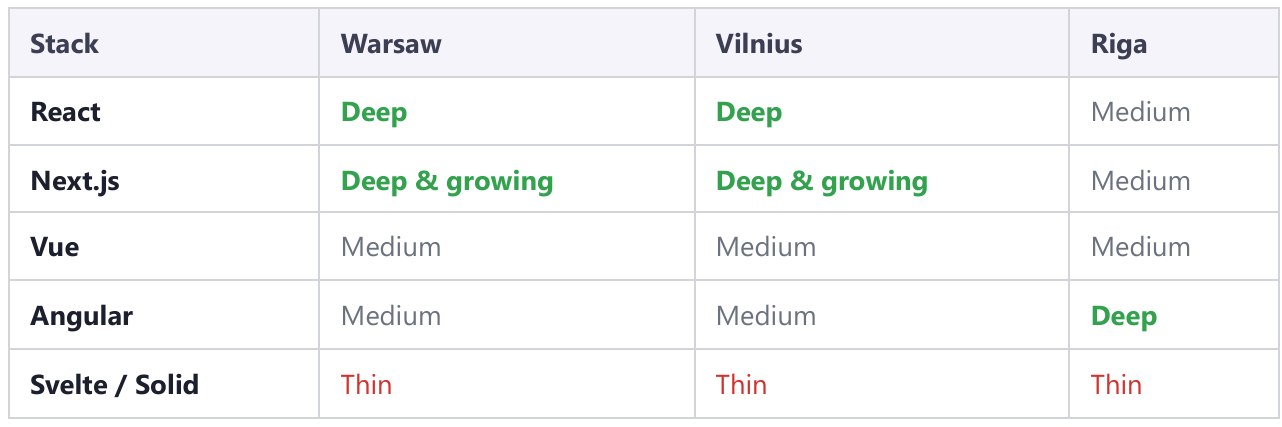
React - deepest pool in CEE by a distance. Warsaw and Vilnius have the strongest benches. Riga is solid at mid-senior but narrower at staff level.
Next.js - fastest-growing segment in 2026. Warsaw and Vilnius are where the serious depth sits. If your stack is Next.js-first, these are the two cities to start the search.
Vue - consistent across CEE but narrower than React at the senior end. Berlin has a stronger Vue culture than the CEE cities - worth considering if Vue depth is the primary requirement and Western European cost is acceptable.
Angular - skews toward enterprise and fintech. Riga has disproportionate Angular depth driven by a decade of enterprise software companies that standardised on Angular early. If your product runs Angular, Riga is the first market to search - and often the only one you need. Warsaw is also solid.
Svelte, Solid, and other emerging frameworks - fewer than five senior candidates Europe wide at any given time. Plan for a targeted headhunt, not a sourcing funnel.
How to vet for senior frontend skill - not just “I built a CRUD form”
Most frontend interview processes test whether someone can write code. Senior frontend craft shows up somewhere else entirely. Four signals that actually separate senior from mid-level:
1. Code review of a representative repo. Give them a real frontend codebase - not a toy example - and ask them to review it as if they were the tech lead doing a PR review. Senior engineers find systemic issues: component boundary decisions, state management patterns, performance anti-patterns, accessibility gaps. Mid-level engineers find style issues and missing comments. The difference is immediate.
2. Live performance audit - debug a real Lighthouse score. Take a real page from your product and ask them to walk through a Lighthouse audit live. A senior engineer identifies the specific causes of a poor CLS, LCP, or TTI score and explains the remediation. An engineer who has only read about Core Web Vitals gives a generic answer. This separates people who have shipped performance work from people who know the vocabulary.
3. Accessibility interview - live A11y review of a public page. Ask them to review a public page for accessibility issues: keyboard navigation, ARIA misuse, focus management problems, color contrast failures. Senior engineers who have owned A11y work walk you through this fluently. Engineers who have not cannot fake it.
4. Design system reasoning. Ask them to explain why their last component library is shaped the way it is. Not what it contains - why the architecture. Why those component boundaries? Why that token structure? Why that theming approach? Senior engineers who have built or owned a design system have strong, specific opinions formed by production constraints. Engineers who have only consumed one give a vague answer about flexibility.
These four signals fit into a 90-minute structured interview. Add a take-home code review exercise and you have a process that catches the gaps a coding test alone will not find.
When a "frontend development partner" makes sense - and when a hire does
There are legitimate scenarios for both. The mistake is not choosing wrong - it is not thinking about the break-even before you commit.
A partner or agency makes sense when:
• The work has a hard end date - a time-bounded redesign, a design-system bootstrap built once;
• You need burst capacity alongside an existing team for a specific sprint;
• The work will not exist in 6 months.
An in-house hire makes sense when:
• Product ownership at 0.5+ FTE for 6+ months;
• Long-term design partnership and performance ownership;
• A11y as a continuous programme, not a one-off audit;
• Building institutional frontend knowledge that stays with the company.
The break-even is approximately six months of work or 0.5 FTE equivalent. Below that, a partner or agency is almost always cheaper when you factor in the hiring overhead. Above it, in-house wins on cost and - more importantly - on product quality. A frontend engineer who owns a product long-term ships better work than one billing by the sprint.
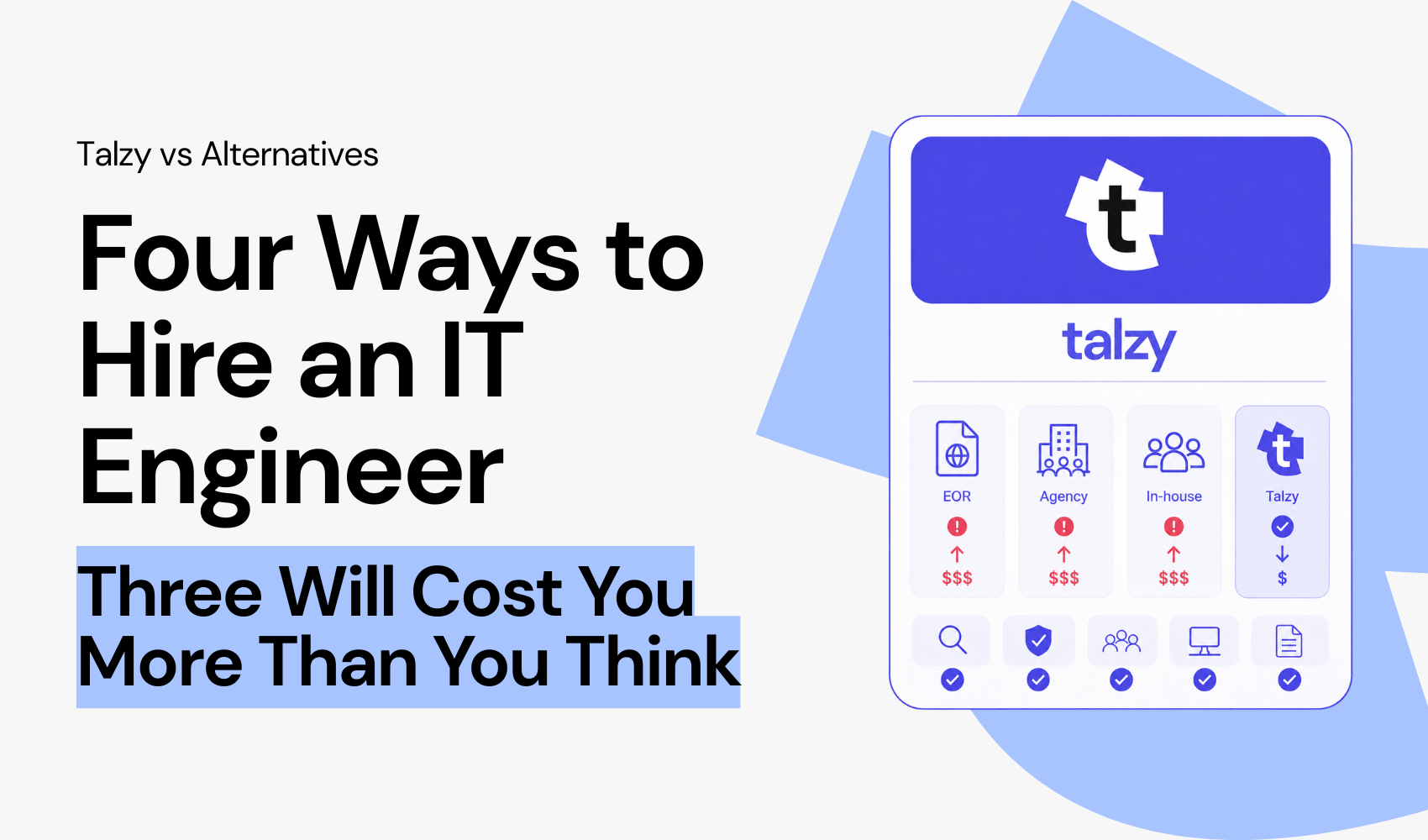
For the full model comparison - EOR platforms, agencies, traditional hiring, and Talzy - four ways to hire from Eastern Europe covers it without the usual sales framing.
Hiring frontend through Talzy
We place frontend engineers across Warsaw, Vilnius, and Riga. React and Next.js are the deepest parts of our pool in Warsaw and Vilnius. Riga is our go-to market for Angular - the depth there is genuine, built on years of enterprise product work, and the cost is the most competitive of the three cities.
The vetting sequence runs: code review exercise against a representative repo, structured technical screen using the four signals above, and a C1 English gate. Before we write the brief, we run a 30-minute calibration call with your hiring manager so the sourcing is targeted from day one. We source, screen, and shortlist - your team does the final interview and makes the call.
Once you approve an offer, we employ the engineer locally in their country of residence under Talzy’s entity - handling the employment contract, payroll, employer taxes, and in-country compliance. We equip them with workspace access, hardware, and software before day one, so their first week starts with a PR, not an IT ticket. After placement, a dedicated Employment Operations Partner runs monthly wellbeing check-ins and quarterly salary benchmarking, keeping retention proactive rather than reactive.
The 12-month comparison against hiring a senior frontend engineer in-house in London is stark:
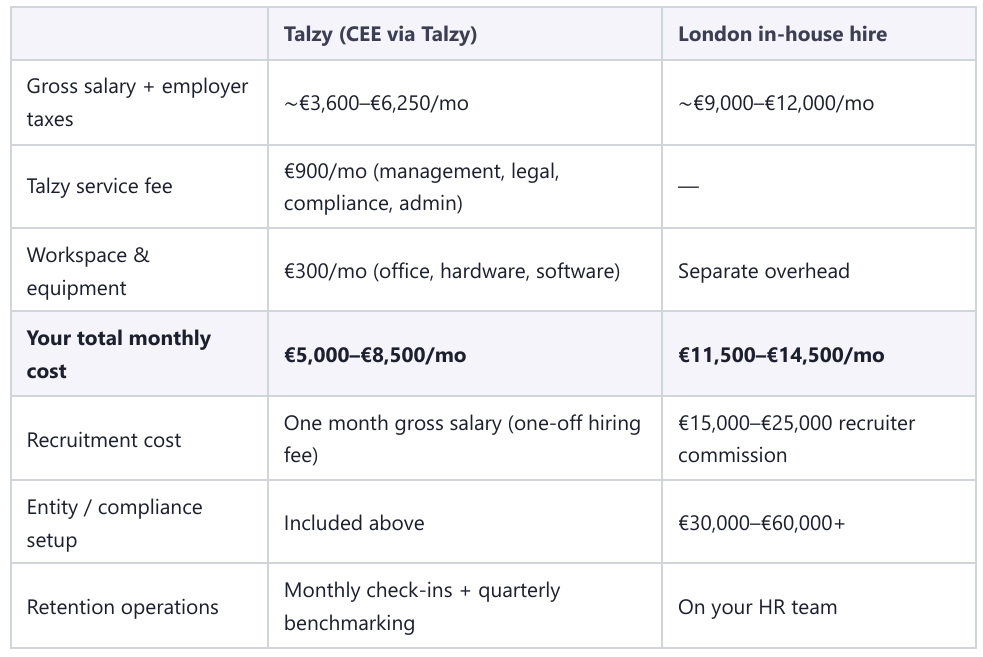
For ongoing platform ownership - a frontend lead who stays close to the product, owns performance, and participates in architecture decisions - the in-house model via Talzy is the right structure. The partner or agency model makes sense for bounded work; this is not that.
RECENT PLACEMENT - ANONYMISED
A Series A product company needed a senior React engineer to own the frontend architecture for a B2B SaaS product. 14 engineers on the team, no dedicated frontend lead. We searched across Warsaw, Vilnius, and Riga, screened 11 candidates, ran 2 through final trial. Placed a Warsaw-based engineer, 7 years experience, strong Next.js and design-system ownership, prior fintech product work. Fully loaded: €6,800/month. London equivalent: €12,500–€14,000/month.
If you are also building out backend alongside frontend, the senior backend developers in CEE guide covers the same markets and the same process.
Start a conversation and we will tell you honestly whether the frontend profile you need is in our pool in your timeline.
Frequently asked questions
Evaluating how to build your European team?
Tell us the role and team size. We'll send an honest read on whether Talzy is the right partner - and if it is not, we'll tell you that too.